Nº 555 of 605
Agent at work hero
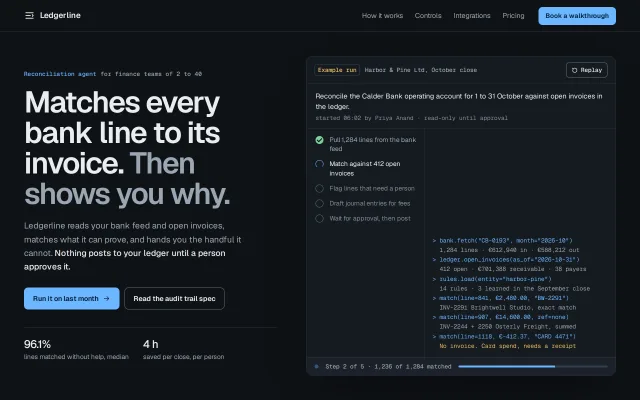
A hero for an invented reconciliation agent that shows a labelled example run: a five-step plan ticking off, tool calls and results scrolling, a journal diff, and a status line.
Preview
Use it
Free to use · credit appreciated1 Once, in your project · Node 22.20+
npx skills add SusanAcharya/Design-Lounge 2 Then ask
Using the Design Lounge skill, build "Agent at work hero" (piece hero-agent-at-work) in my stack. Match its brief; restyle it onto my product's theme.
No skill? Paste the brief instead. It carries the numbers, tokens and behaviour.
<!-- Design Lounge Nº 555 · "Agent at work hero" · www.designlounge.live -->

# Agent at work hero

> **Build brief for a coding agent.** Rebuild this piece in the reader's stack. If they haven't said which stack, ask once, then default to semantic HTML + CSS + a little vanilla JS. Match the numbers below; don't "improve" them.

## What it is

The top of a site for Ledgerline, an invented agent that reconciles a company's bank feed against its open invoices. The headline names the job ("Matches every bank line to its invoice. Then shows you why.") and the right half shows the agent doing it, in a panel plainly tagged "Example run": the task as a person wrote it, a five-step plan that ticks off, a log of tool calls and their results, a drafted journal entry as a diff, and a status line that ends on "Waiting for approval … no writes yet". It is honest about what an agent does: the copy and the run both say nothing is posted until a person approves. The detail worth copying is that the first frame is already mid-run, so the panel reads as work in progress rather than an empty terminal.

## Reference behaviour

1. Initial state: step 1 ("Pull 1,284 lines from the bank feed") is done, step 2 ("Match against 412 open invoices") is spinning, steps 3–5 are idle. The log already shows ten lines (bank fetch, open invoices, match rules, two matches, each with its result) and the status reads "Step 2 of 5 · 1,031 of 1,284 matched" with the bar at 52%.
2. The run continues on its own clock: 1.8s after load a card spend with no invoice is flagged (status 1,236, 68%), then step 3 starts (flag six lines), then step 4 (draft journal JE-1031 shown as a green `+ Dr` line and a red `- Cr` line), each 1.1–1.3s apart. The status text and bar update with each event; the bar width eases over 600ms.
3. Final state, about 5.4s after load: steps 1–4 done (green filled circle with a check), step 5 ("Wait for approval, then post") shows a dashed amber ring, the status dot turns amber and stops pulsing, and the status reads "Waiting for approval · 4 entries · 6 flags · 3m 12s · no writes yet". The run then holds; it never loops by itself.
4. New log lines fade and rise 6px over 280ms (expo out) and push older lines up; the log keeps at most 26 lines.
5. "Replay" in the panel header clears the plan and log and plays every event from the start at 120ms per instant event plus each event's delay (full run about 8s).
6. Hover the primary buttons: brightness 1.08; ghost buttons: ring goes from `#5D6A78` to `--ink`.
7. Reduced motion: the final state is rendered at once, no spinner, no pulse, no line animation. Replay redraws the final state.

## Structure

```
1280 × 800
┌──────────────────────────────────────────────────────────────────────┐
│ ≡ Ledgerline            How it works  Controls  Integrations  Pricing [Book a walkthrough] │ nav 64
├─────────────────────────────────────┬────────────────────────────────┤
│ Reconciliation agent for finance…   │ [Example run] Harbor & Pine…  [↻ Replay] │ 12/16
│                                     ├────────────────────────────────┤
│ Matches every                        │ task sentence 14px            │
│ bank line to its      60/1.02        │ started 06:02 by Priya Anand…  │
│ invoice. Then shows                  ├──────────┬─────────────────────┤
│ you why.  (second sentence ink-2)    │ ✓ Pull…  │ > bank.fetch(…)     │
│ lede 17/1.6, max 470                 │ ◌ Match… │   1,284 lines · …   │
│ [Run it on last month →] [Read the…] │ ○ Flag…  │ > match(line=841…)  │
│ ─────────────────────────            │ ○ Draft… │   INV-2291 …        │
│ 96.1%          4 h                   │ ○ Wait…  │ + Dr 6810 …  - Cr … │
│                                      ├──────────┴─────────────────────┤
│                                      │ • Step 2 of 5 · 1,236 …  ▬▬▬▬░ │ status
└─────────────────────────────────────┴────────────────────────────────┘

… 134 more lines. Copy or download for the full brief. Loading the source…Brief
174 linesBuild brief for a coding agent. Rebuild this piece in the reader’s stack. If they haven’t said which stack, ask once, then default to semantic HTML + CSS + a little vanilla JS. Match the numbers below; don’t “improve” them.
What it is
The top of a site for Ledgerline, an invented agent that reconciles a company’s bank feed against its open invoices. The headline names the job (“Matches every bank line to its invoice. Then shows you why.”) and the right half shows the agent doing it, in a panel plainly tagged “Example run”: the task as a person wrote it, a five-step plan that ticks off, a log of tool calls and their results, a drafted journal entry as a diff, and a status line that ends on “Waiting for approval … no writes yet”. It is honest about what an agent does: the copy and the run both say nothing is posted until a person approves. The detail worth copying is that the first frame is already mid-run, so the panel reads as work in progress rather than an empty terminal.
Reference behaviour
- Initial state: step 1 (“Pull 1,284 lines from the bank feed”) is done, step 2 (“Match against 412 open invoices”) is spinning, steps 3–5 are idle. The log already shows ten lines (bank fetch, open invoices, match rules, two matches, each with its result) and the status reads “Step 2 of 5 · 1,031 of 1,284 matched” with the bar at 52%.
- The run continues on its own clock: 1.8s after load a card spend with no invoice is flagged (status 1,236, 68%), then step 3 starts (flag six lines), then step 4 (draft journal JE-1031 shown as a green
+ Drline and a red- Crline), each 1.1–1.3s apart. The status text and bar update with each event; the bar width eases over 600ms. - Final state, about 5.4s after load: steps 1–4 done (green filled circle with a check), step 5 (“Wait for approval, then post”) shows a dashed amber ring, the status dot turns amber and stops pulsing, and the status reads “Waiting for approval · 4 entries · 6 flags · 3m 12s · no writes yet”. The run then holds; it never loops by itself.
- New log lines fade and rise 6px over 280ms (expo out) and push older lines up; the log keeps at most 26 lines.
- “Replay” in the panel header clears the plan and log and plays every event from the start at 120ms per instant event plus each event’s delay (full run about 8s).
- Hover the primary buttons: brightness 1.08; ghost buttons: ring goes from
#5D6A78to--ink. - Reduced motion: the final state is rendered at once, no spinner, no pulse, no line animation. Replay redraws the final state.
Structure
1280 × 800
┌──────────────────────────────────────────────────────────────────────┐
│ ≡ Ledgerline            How it works  Controls  Integrations  Pricing [Book a walkthrough] │ nav 64
├─────────────────────────────────────┬────────────────────────────────┤
│ Reconciliation agent for finance…   │ [Example run] Harbor & Pine…  [↻ Replay] │ 12/16
│                                     ├────────────────────────────────┤
│ Matches every                        │ task sentence 14px            │
│ bank line to its      60/1.02        │ started 06:02 by Priya Anand…  │
│ invoice. Then shows                  ├──────────┬─────────────────────┤
│ you why.  (second sentence ink-2)    │ ✓ Pull…  │ > bank.fetch(…)     │
│ lede 17/1.6, max 470                 │ ◌ Match… │   1,284 lines · …   │
│ [Run it on last month →] [Read the…] │ ○ Flag…  │ > match(line=841…)  │
│ ─────────────────────────            │ ○ Draft… │   INV-2291 …        │
│ 96.1%          4 h                   │ ○ Wait…  │ + Dr 6810 …  - Cr … │
│                                      ├──────────┴─────────────────────┤
│                                      │ • Step 2 of 5 · 1,236 …  ▬▬▬▬░ │ status
└─────────────────────────────────────┴────────────────────────────────┘
grid: 1fr | 620px, gap 56, padding 40 48; panel max-height 640, plan column 236px
<nav aria-label="Primary">: logo link, four links, small accent button.<section class="hero" aria-labelledby="h">- Copy
div: mono eyebrowp,h1(second sentence in aspan), lede, button row,.factswith two figures. .run[role=region][aria-label="Example run of the agent"]:.rhead(tag, run title, Replaybutton),.task(p+small),.bodygrid withol.planand.log[aria-hidden],.status[role=status][aria-live=polite]with dot, text, bar.
- Copy
Tokens
:root {
  --bg: #0f1216;        /* page */
  --panel: #151a20;     /* run panel */
  --panel-2: #1b2129;   /* status bar */
  --line: #262e38;      /* hairlines */
  --line-2: #34404d;    /* tag border, bar track */
  --ink: #e9edf1;
  --ink-2: #9aa6b2;     /* secondary, results */
  --ink-3: #7f8b97;     /* idle plan steps, meta */
  --ring: #5d6a78;      /* ghost buttons, idle step rings */
  --accent: #6cb6ff;    /* calls, spinner, bar, primary button */
  --accent-ink: #06223d;
  --add: #7fd19b;       /* done steps, + lines */
  --del: #f2857a;       /* - lines */
  --warn: #f0c36a;      /* example tag, flags, waiting */
  --sans: "Geist", system-ui, sans-serif;
  --mono: "Geist Mono", ui-monospace, monospace;
  --fs-h1: 60px; --fs-lede: 17px; --fs-fact: 22px; --fs-body: 14px; --fs-plan: 13px; --fs-mono: 12px;
  --r-panel: 14px; --r-btn: 8px; --r-tag: 4px;
  --space: 4px 8px 10px 12px 14px 16px 18px 28px 36px 40px 48px 56px;
  --shadow-panel: 0 40px 80px -40px rgba(0, 0, 0, .6);
  --ease: cubic-bezier(.2, .7, .2, 1);
  --expo: cubic-bezier(.16, 1, .3, 1);
  --t-micro: 160ms; --t-line: 280ms; --t-bar: 600ms;
}
Typography
| Role | Family | Size | Weight | Line-height | Tracking | Notes |
|---|---|---|---|---|---|---|
| h1 | Geist | 60px (50 under 1180; clamp(36px,10vw,52px) phone) | 600 | 1.02 | -0.035em | second sentence --ink-2 |
| Lede | Geist | 17px | 400, last sentence 500 ink | 1.6 | 0 | |
| Facts | Geist | 22px over 13px | 500 / 400 | 1.1 / 1.5 | -0.02em | |
| Logo | Geist | 16px | 600 | 1 | 0 | |
| Task, buttons, nav | Geist | 14px | 400 / 600 | 1.5 | 0 | |
| Plan steps | Geist | 13px | 400 | 1.4 | 0 | |
| Eyebrow, header, log, status | Geist Mono | 12px | 400 / 500 | 1.6 | 0.02em eyebrow | > prefix on calls |
Motion
| Thing | Trigger | Property | From → to | Duration | Easing | Reduced motion |
|---|---|---|---|---|---|---|
| Log line | event | opacity, translateY | 0, 6px → 1, 0 | 280ms | expo out | none |
| Spinner | step running | rotate | 0 → 360° | 900ms loop | linear (spinner) | static ring |
| Plan step colour | step change | color | ink-3 → ink → ink-2 | 280ms | standard | instant |
| Progress bar | status event | width | previous → new % | 600ms | expo out | instant |
| Status dot | running | opacity | 1 → .35 → 1 | 1.4s loop | standard | static |
| Event clock | load | sequence | 15 events instant, then 600ms + 1.1–1.3s gaps | ≈5.4s | n/a | final state |
| Replay | click | sequence | from empty | ≈8s | n/a | final state |
States
- Step idle: 16px ring
--ring, text--ink-3. Running: accent ring with a transparent right edge, spinning; text--ink. Done: filled--addwith a dark check; text--ink-2. Waiting: dashed--warnring; text--ink. - Log line kinds: call (accent,
>prefix), result (ink-2, 14px indent), flag (warn, indented), journal header (ink), add (green on 8% green), del (red on 8% red). - Status running: pulsing accent dot. Holding: amber dot, no pulse, bar full.
- Replay button: 1px
--ringborder; hover border--ink. - Focus-visible: 2px accent outline, 3px offset.
Accessibility
- The panel is a labelled region; the visual log is
aria-hiddenbecause it changes quickly. The status line isrole="status"witharia-live="polite", so a screen reader hears each step summary, not every tool call. - The plan is an ordered list; state is visible in text colour and icon shape, and the status line repeats it in words.
- “Example run” is a visible tag, not hover text, so nobody mistakes the panel for their own data.
- Contrast on
--panel: ink 14.6:1, ink-2 7.0:1, ink-3 5.0:1, accent 8.3:1, warn 11:1, add 10:1, del 7.2:1. Ghost rings#5D6A78are 3.1:1 on the page. - Tab order: logo, four nav links, Book a walkthrough, Run it on last month, Read the audit trail spec, Replay.
Responsive rules
- ≥1280: as drawn.
- 1180: panel 540px, plan column 200px, h1 50px, gap 40px.
- 900–1180: same two columns.
- <900 (phone at 390): body scrolls; one column with copy first and the panel below; the plan sits above the log (full width, hairline under it); the log is 240px tall; the header’s spacer hides and the tag never wraps. No sideways scroll: log lines use
pre-wrapandbreak-word, and calls are written short enough (≤ 46 characters) to stay on one line at 1280.
Acceptance checklist
Always
- The headline names the job the agent does, in plain words.
- The run panel carries a visible “Example run” tag.
- The first frame is mid-run: at least one step done, one running, and a filled log.
- The run ends on a waiting-for-approval state and does not loop by itself; Replay restarts it.
- Copy and the final status both say nothing is written before a person approves.
- The log is
aria-hidden; the status line is a polite live region. - Unfilled controls (ghost buttons, Replay) have rings of at least 3:1.
- Reduced motion renders the final state immediately.
- No horizontal scroll at 390 wide.
This demo
- Plan has five steps from “Pull 1,284 lines from the bank feed” to “Wait for approval, then post”.
- Log includes
bank.fetch("CB-0193", month="2026-10"), threematch(…)calls, oneflag([…])with six line numbers, and JE-1031 as a+ Dr 6810/- Cr 1010pair for €48.50. - Status ends “Waiting for approval · 4 entries · 6 flags · 3m 12s · no writes yet”.
- Facts read “96.1%” and “4 h”.
Implementation notes
One event list drives everything. Each entry is [delayMs, kind, payload]; the same apply() renders the first frame, the timed run and the reduced-motion final state:
const E = [[0,'step',0], [0,'call','bank.fetch("CB-0193", month="2026-10")'], /* … */
           [1300,'step',4], [0,'hold','Waiting for approval · 4 entries · 6 flags · 3m 12s · no writes yet',100]];
function run() {
  let i = 0, t = 0;
  for (; i < E.length && i < 15; i++) apply(E[i]);          // first frame is already mid-run
  for (; i < E.length; i++) { t += E[i][0]; const e = E[i]; timers.push(setTimeout(() => apply(e), t + 600)); }
}
Bottom-anchored log. Flex column with justify-content: flex-end and hidden overflow; new lines append at the end and old ones fall off the top. Cap the node count:
.log { display: flex; flex-direction: column; justify-content: flex-end; overflow: hidden; }
.ln  { animation: in 280ms cubic-bezier(.16,1,.3,1) both; white-space: pre-wrap; word-break: break-word; }
@keyframes in { from { opacity: 0; transform: translateY(6px); } }
Plan icons from one element. The same i is a ring, a spinner (transparent right border plus rotation), a filled check (pseudo-element tick) or a dashed wait ring, chosen by the li class.
Common mistakes: an empty terminal on first paint; logs that loop forever and read as fake; tool calls so long they wrap into unreadable fragments; a mask fade on the log that drops old lines below contrast; announcing every log line to screen readers.
Details
- Palette
- Type
- Geist · Geist Mono
- Motion
- Subtle motion
- Build
- One session
- Tags
Studied
LinearShow the product doing the work. Fade it at the edges and keep one colour for what matters.
All sourcesSimilar
AI prompt cycle hero
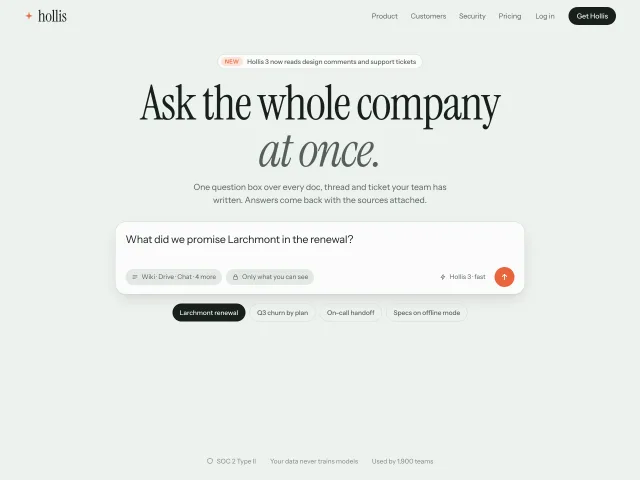
A Hollis product hero whose question box types four real company prompts, then streams a sourced answer; chips, Enter and New question all drive the same cycle.
Hero with a live browser card
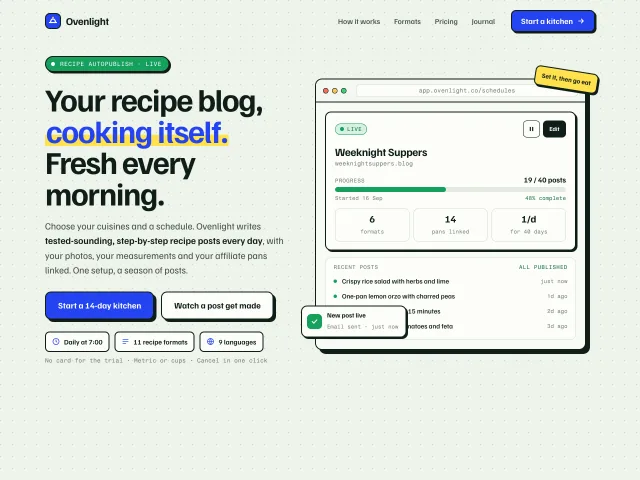
A SaaS hero: marker-highlighted headline, hard-shadow buttons, and a browser mockup whose schedule card ticks up, adds a post and pops a toast every 4.2s.
Product window tilt hero
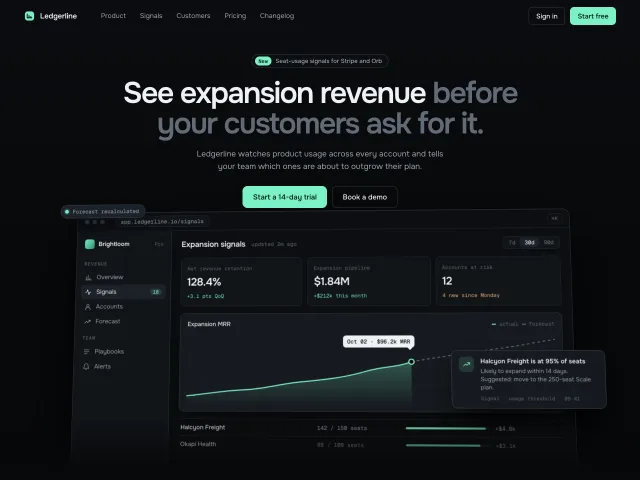
A dark SaaS hero whose div-built app window tilts up to 8° toward the cursor, with sidebar, chart, chip and toast parallaxing at four translateZ depths.
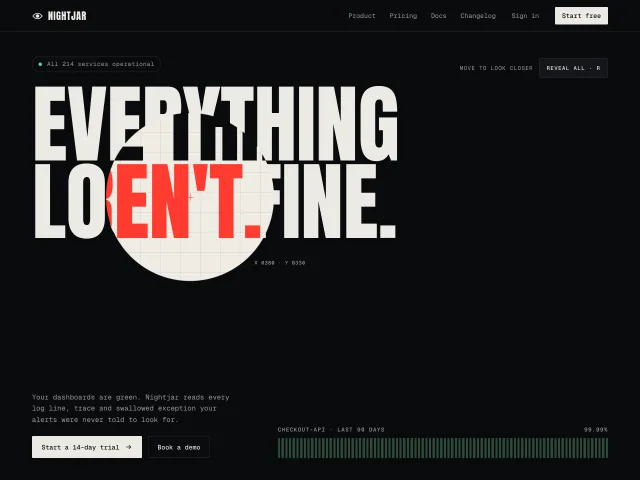
Flashlight reveal hero
A dark observability hero where the cursor is a hard-edged torch that cuts a light disc through the calm headline to expose a second, true one underneath.
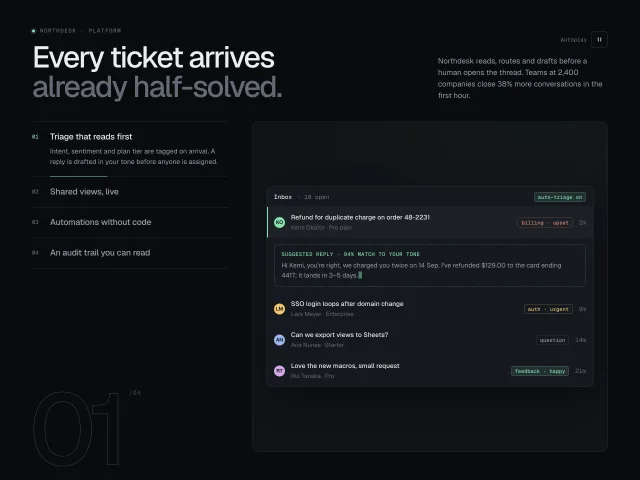
Tabbed feature preview
Four vertical feature tabs with 6s autoplay progress hairlines; the preview pane crossfades between CSS-built product UIs, with a giant outlined step numeral.
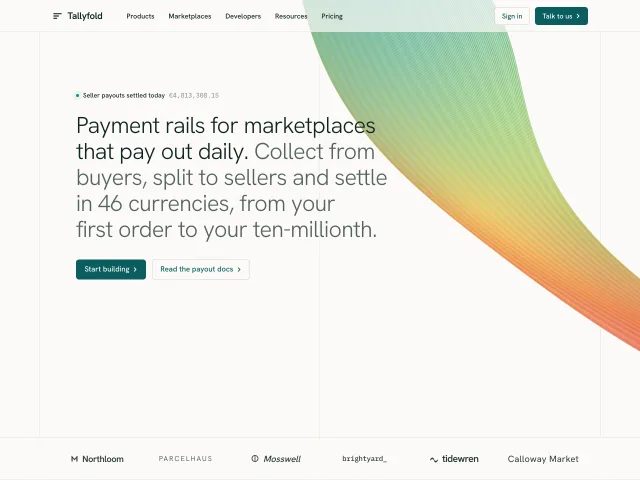
Silk ribbon hero with live ticker
A warm-paper fintech hero: a 150-fibre canvas ribbon sweeps off the top right, a two-tone light headline, a live payout ticker and chevrons that grow into arrows.