Nº 076 of 520
Text scramble reveal
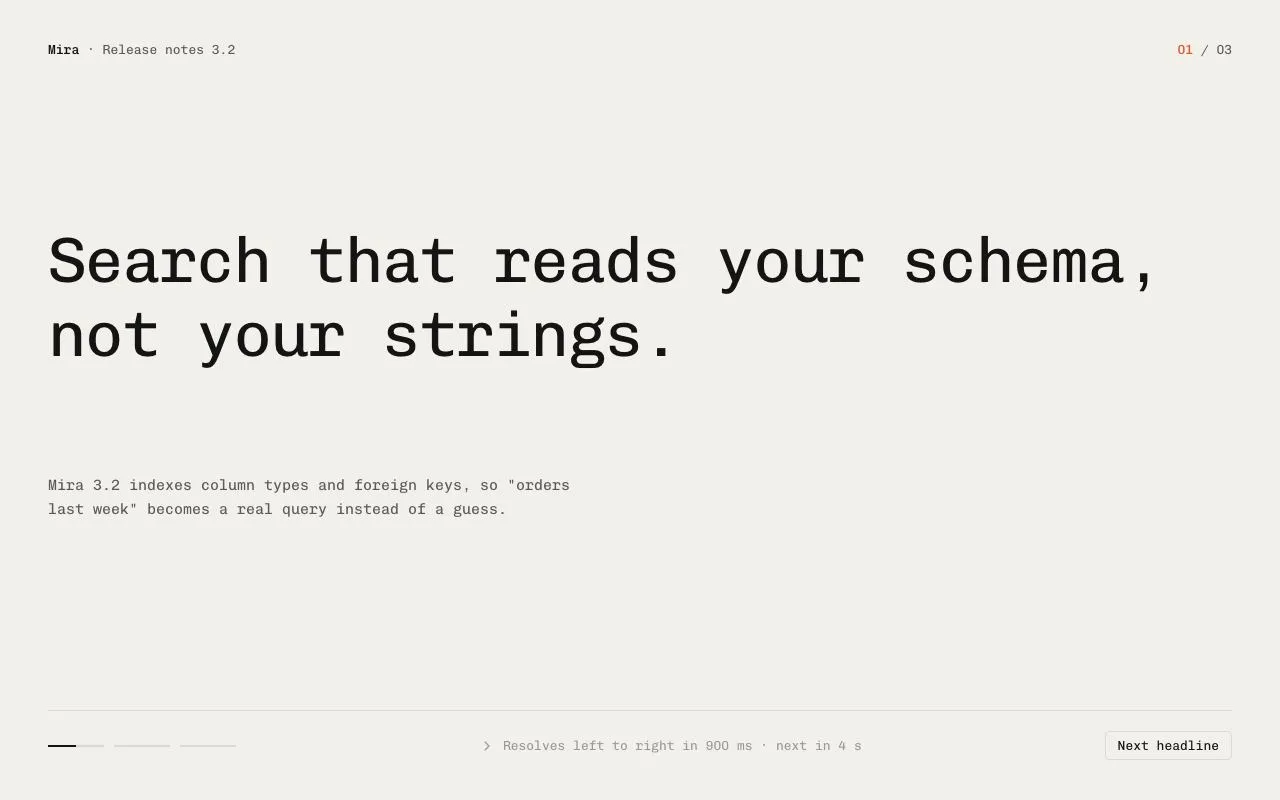
A 64px monospace headline resolves from random glyphs to its final text left to right in 900ms; three headlines cycle every 4s with a progress dash per headline; click or Space skips.
Preview
Use it
Free to use · credit appreciated1 Once, in your project
npx skills add SusanAcharya/Design-Lounge 2 Then ask
Using the Design Lounge skill, build "Text scramble reveal" (piece text-scramble-reveal) in my stack. Match its brief; restyle it onto my product's theme.
No skill? Paste the brief instead. It carries the numbers, tokens and behaviour.
<!-- Design Lounge Nº 076 · "Text scramble reveal" · www.designlounge.live -->

# Text scramble reveal

> **Build brief for a coding agent.** Rebuild this piece in the reader's stack. If they haven't said which stack, ask once, then default to semantic HTML + CSS + a little vanilla JS. Match the numbers below; don't "improve" them.

## What it is

A release-notes hero for a database tool ("Mira 3.2"). A 64px Chivo Mono headline starts as a run of grey punctuation glyphs and resolves into its real characters from left to right over 900ms; unresolved glyphs re-randomise every third frame so they flicker without strobing. A one-line sub-caption sits under it, an orange block cursor blinks at the resolving edge, and three 56 × 2px dashes at the bottom show which of the three headlines is up and how far through its 4s dwell it is. Clicking anywhere, pressing Space or → skips to the next headline. The detail worth copying is the per-character resolve schedule — `150ms + (i / n) × 600ms + random(0–150ms)` — which gives a left-to-right sweep that is never a perfectly straight edge.

## Reference behaviour

1. Initial state (t = 0): header "Mira · Release notes 3.2" left, "01 / 03" right (number in orange). Headline area shows all characters of headline 1 as grey glyphs; spaces are real spaces. First dash starts filling. Sub-caption for headline 1 is already fully visible.
2. Each character *k* (of *n*, spaces excluded) has a resolve time `at[k] = 150 + (k / n) × 600 + random() × 150` ms — so the first character resolves between 150 and 300ms, the last between 750 and 900ms. Before `at[k]` the character is a random glyph from `<>-_\/[]{}=+*^?#%&@!;:~` rendered in `--ink-3` at weight 300; from `at[k]` it is the true character in `--ink` at weight 400.
3. Every third animation frame (~50ms at 60fps), all still-unresolved glyphs are re-randomised. Between those frames they hold, so the texture reads as flicker, not noise.
4. While any character is unresolved, a `.6ch × .9em` orange block cursor is appended after the text and blinks (1s, `steps(2)`); it is removed on the frame everything resolves.
5. The active dash's fill scales from 0 to 1 over 4000ms, linear. Dashes for earlier headlines are full; later ones empty.
6. At t = 4000ms: the next headline plays (index wraps 3 → 1). Its sub-caption swaps instantly; "02 / 03" updates; the headline's hidden live text updates to the final string.
7. Click anywhere on the page, or press Space / ArrowRight with nothing focused: cancel the current frame loop and dwell timer, play the next headline immediately. The "Next headline" button does the same and is keyboard-reachable.
8. The headline box reserves three lines of height (`min-height: 64 × 1.15 × 3 = 220.8px`) so switching between a one-line and a two-line headline does not move the caption or dashes.
9. With `prefers-reduced-motion: reduce`: no scramble — the final text is set directly (a 200ms opacity transition is allowed); no blinking cursor; dashes jump to full when active. The 4s cycle and skipping still work.

## Structure

```
1280 × 800  (page padding 40px 48px)
┌───────────────────────────────────────────────────────────────────────┐
│ Mira · Release notes 3.2                                    01 / 03   │ top 13px
│                                                                       │
│                                                                       │
│  Search that reads your                                               │ h1 64px mono
│  schema, not your str#^gs█          ← resolving edge + cursor         │ min-height 3 lines
│                                                                       │ (max-width 30ch)
│  Mira 3.2 indexes column types and foreign keys, so "orders last      │ sub 15px, 62ch
│  week" becomes a real query instead of a guess.                       │
│                                                                       │
├───────────────────────────────────────────────────────────────────────┤ 1px line
│ ▬▬▬▬ ▬▬▬▬ ▬▬▬▬    › Resolves left to right in 900 ms · next in 4 s   [ Next headline ] │ bottom
└───────────────────────────────────────────────────────────────────────┘
```

… 185 more lines. Copy or download for the full brief. Loading the source…Brief
225 linesBuild brief for a coding agent. Rebuild this piece in the reader’s stack. If they haven’t said which stack, ask once, then default to semantic HTML + CSS + a little vanilla JS. Match the numbers below; don’t “improve” them.
What it is
A release-notes hero for a database tool (“Mira 3.2”). A 64px Chivo Mono headline starts as a run of grey punctuation glyphs and resolves into its real characters from left to right over 900ms; unresolved glyphs re-randomise every third frame so they flicker without strobing. A one-line sub-caption sits under it, an orange block cursor blinks at the resolving edge, and three 56 × 2px dashes at the bottom show which of the three headlines is up and how far through its 4s dwell it is. Clicking anywhere, pressing Space or → skips to the next headline. The detail worth copying is the per-character resolve schedule — 150ms + (i / n) × 600ms + random(0–150ms) — which gives a left-to-right sweep that is never a perfectly straight edge.
Reference behaviour
- Initial state (t = 0): header “Mira · Release notes 3.2” left, “01 / 03” right (number in orange). Headline area shows all characters of headline 1 as grey glyphs; spaces are real spaces. First dash starts filling. Sub-caption for headline 1 is already fully visible.
- Each character k (of n, spaces excluded) has a resolve time
at[k] = 150 + (k / n) × 600 + random() × 150ms — so the first character resolves between 150 and 300ms, the last between 750 and 900ms. Beforeat[k]the character is a random glyph from<>-_\/[]{}=+*^?#%&@!;:~rendered in--ink-3at weight 300; fromat[k]it is the true character in--inkat weight 400. - Every third animation frame (~50ms at 60fps), all still-unresolved glyphs are re-randomised. Between those frames they hold, so the texture reads as flicker, not noise.
- While any character is unresolved, a
.6ch × .9emorange block cursor is appended after the text and blinks (1s,steps(2)); it is removed on the frame everything resolves. - The active dash’s fill scales from 0 to 1 over 4000ms, linear. Dashes for earlier headlines are full; later ones empty.
- At t = 4000ms: the next headline plays (index wraps 3 → 1). Its sub-caption swaps instantly; “02 / 03” updates; the headline’s hidden live text updates to the final string.
- Click anywhere on the page, or press Space / ArrowRight with nothing focused: cancel the current frame loop and dwell timer, play the next headline immediately. The “Next headline” button does the same and is keyboard-reachable.
- The headline box reserves three lines of height (
min-height: 64 × 1.15 × 3 = 220.8px) so switching between a one-line and a two-line headline does not move the caption or dashes. - With
prefers-reduced-motion: reduce: no scramble — the final text is set directly (a 200ms opacity transition is allowed); no blinking cursor; dashes jump to full when active. The 4s cycle and skipping still work.
Structure
1280 × 800  (page padding 40px 48px)
┌───────────────────────────────────────────────────────────────────────┐
│ Mira · Release notes 3.2                                    01 / 03   │ top 13px
│                                                                       │
│                                                                       │
│  Search that reads your                                               │ h1 64px mono
│  schema, not your str#^gs█          ← resolving edge + cursor         │ min-height 3 lines
│                                                                       │ (max-width 30ch)
│  Mira 3.2 indexes column types and foreign keys, so "orders last      │ sub 15px, 62ch
│  week" becomes a real query instead of a guess.                       │
│                                                                       │
├───────────────────────────────────────────────────────────────────────┤ 1px line
│ ▬▬▬▬ ▬▬▬▬ ▬▬▬▬    › Resolves left to right in 900 ms · next in 4 s   [ Next headline ] │ bottom
└───────────────────────────────────────────────────────────────────────┘<body>— flex column,cursor: pointer,user-select: none, padding 40px 48px..top— flex space-between: product label (<b>Mira</b> · Release notes 3.2) and.idx(“<b id="n">01</b> / 03”).<main>— flex column, centred vertically, gap 28px:.sr(role="status", visually hidden, holds the resolved headline),<h1 id="h" aria-hidden="true">(rendered glyphs),<p class="sub">..bottom— 1px top hairline, flex space-between:.dots(three.dotwith an inner<i>fill,aria-hidden),.hint(16px chevron SVG + text),<button class="skip">Next headline</button>.
Headlines and captions:
| # | Headline | Caption |
|---|---|---|
| 1 | Search that reads your schema, not your strings. | Mira 3.2 indexes column types and foreign keys, so “orders last week” becomes a real query instead of a guess. |
| 2 | Ship the migration. Keep the weekend. | Dry runs now diff the live schema against your branch and estimate lock time per table before anything touches production. |
| 3 | Latency budgets, enforced at merge. | Set a p95 target per endpoint. Pull requests that would blow it get a red check and the query plan that caused it. |
Tokens
:root {
  /* colour — off-white paper, near-black, grey glyphs, one orange */
  --bg: #f2f0eb;
  --ink: #141414;         /* resolved text, active dash fill */
  --ink-2: #5c5a55;       /* captions, header text */
  --ink-3: #9b9891;       /* unresolved glyphs, hint */
  --line: #dcd9d1;        /* hairline, empty dashes, button border */
  --accent: #e4572e;      /* cursor, index number, focus ring */

  /* type */
  --mono: "Chivo Mono", ui-monospace, monospace;
  --head: 64px;
  --head-lh: 1.15;
  --measure: 30ch;        /* headline max width */
  --sub-measure: 62ch;

  /* layout */
  --pad: 40px 48px;
  --dash-w: 56px;
  --dash-h: 2px;
  --cursor-w: .6ch;

  /* motion */
  --t-scramble: 900ms;    /* last character resolves by here */
  --t-lead: 150ms;        /* first character earliest */
  --t-sweep: 600ms;       /* linear spread across characters */
  --t-jitter: 150ms;      /* random addition per character */
  --glyph-hold: 3;        /* frames between glyph re-randomisation */
  --t-dwell: 4000ms;      /* per headline */
  --t-blink: 1s;
  --t-micro: 160ms;
  --ease: cubic-bezier(.2, .7, .2, 1);
}
Typography
| Role | Family | Size | Weight | Line-height | Tracking | Case | Notes |
|---|---|---|---|---|---|---|---|
| Headline | Chivo Mono | 64px | 400 | 1.15 | −0.02em | sentence | white-space: pre-wrap, max-width 30ch |
| Unresolved glyph | Chivo Mono | 64px | 300 | 1.15 | −0.02em | — | colour --ink-3 |
| Caption | Chivo Mono | 15px | 400 | 1.6 | 0 | sentence | max-width 62ch, --ink-2 |
| Header / footer | Chivo Mono | 13px | 400 (labels 500) | 1.5 | 0 | sentence | |
| Index | Chivo Mono | 13px | 500 | 1.5 | 0 | numerals | tabular, accent |
| Button | Chivo Mono | 13px | 400 | 1.5 | 0 | sentence | 6px 12px padding, 4px radius |
| Cursor | — | .6ch × .9em | — | — | — | — | --accent block, vertical-align: -.1em, margin-left: .1ch |
Only one family is loaded (300/400/500). Mono is what makes the effect work: every glyph has the same advance, so the line never reflows while it resolves.
Motion
| Element | Trigger | Property | From → To | Duration | Easing | Notes |
|---|---|---|---|---|---|---|
| character k | play | content, colour, weight | random glyph (--ink-3, 300) → true char (--ink, 400) | instant at at[k] | — | at[k] = 150 + k/n × 600 + rand × 150 ms |
| unresolved glyphs | every 3rd frame | content | glyph → new random glyph | — | — | ~50ms cadence at 60fps |
.c cursor | while unresolved | opacity | 1 ↔ 0 | 1s | steps(2, end), infinite | removed when done |
.dot.on i | play | scaleX | 0 → 1 | 4000ms | linear, forwards | origin left |
.dot.done i | headline passed | scaleX | 1 | 0 | — | static |
.skip | hover | border-color | --line → --ink-3 | 160ms | linear |
Worked schedule for headline 2 (“Ship the migration. Keep the weekend.”, n = 37, 5 spaces):
| k | char | earliest | latest |
|---|---|---|---|
| 0 | S | 150ms | 300ms |
| 9 | m | 296ms | 446ms |
| 18 | . | 442ms | 592ms |
| 27 | e | 588ms | 738ms |
| 36 | . | 734ms | 884ms |
Because of the jitter, character 18 can resolve before character 15 — that is intended; the sweep should look like a front, not a wipe.
Reduced motion: skip the frame loop entirely (set textContent), h1 { transition: opacity 200ms }, cursor animation: none, dashes transform: scaleX(1) when active.
States
- Resolving: mixed grey/black characters with the orange cursor at the end.
- Resolved: all
--ink, no cursor; dash still filling. - Dash states:
done(full,--ink),on(filling), default (empty--line). - Hover (page): cursor is
pointereverywhere to signal “click to skip”. - Hover (button): border
--ink-3. Focus-visible (button): 2px--accentoutline, offset 2px. - Reduced motion: static text swap every 4s.
- Dwell: fully resolved, cursor gone, dash filling — this is the state the page spends 78% of its time in, so it must look finished on its own.
- Wrap (3 → 1): the three dashes reset (
doneremoved from all) before the first refills.
Accessibility
- The visible
<h1>isaria-hidden="true"because its content is noise for most of a second. A visually hiddenrole="status"element holds the final headline and is updated at the start of each play, so screen readers announce the real sentence once per headline. - The “Next headline”
<button>is the keyboard path; Space/→ shortcuts only fire whendocument.bodyis the event target, so pressing Space on the focused button does not advance twice. - Body click ignores clicks that originate on the button (
closest('.skip')) for the same reason. - Dashes are
aria-hidden; the “01 / 03” index conveys position in text. - Contrast:
--inkon--bg15.7:1;--ink-25.9:1;--ink-3glyphs 2.9:1 — intentionally low, they are transient noise;--accenton--bg3.6:1 (used for a 13px number and a cursor, not body text). - The cursor blink is 1Hz and small; the glyph flicker is confined to the headline and stops within 900ms — no sustained flashing.
Responsive rules
- ≥ 1280: as specified.
- 1024–1279:
--head: 56px; measure stays 30ch. - 768–1023:
--head: 44px; padding 32px; caption 14px; hint text hidden, button remains. - < 640:
--head: 30px; padding 20px;min-height4 lines; dashes 40px; the index and product label stack.
Acceptance checklist
- Headline is Chivo Mono 64px/1.15 with
white-space: pre-wrapand a 30ch max width; the box reserves 3 lines. - Every non-space character resolves at
150 + (k/n) × 600 + random × 150ms; the last one is resolved by 900ms. - Unresolved characters are drawn from the glyph set, in
--ink-3at weight 300, and re-randomise every third frame only. - Spaces are never scrambled.
- An orange block cursor (.6ch × .9em) blinks at the end while resolving and disappears on completion.
- Headlines cycle every 4000ms; “01 / 03” and the caption update at the start of each play.
- Three 56 × 2px dashes: previous full, current filling linearly over 4s, next empty.
- Click anywhere, Space, → and the “Next headline” button all skip; none of them can double-advance.
- Skipping cancels the pending
requestAnimationFrameand the 4s timer before starting the next play. - A visually hidden
role="status"element carries the final text; the visible<h1>isaria-hidden. - Reduced motion shows the final text immediately with no cursor and no flicker.
- No layout shift between headlines of different line counts.
-
<,>and&from the glyph set render literally (escaped when building the HTML string). - The rAF loop stops on the frame the last character resolves — no idle loop runs during the dwell.
Implementation notes
Schedule per character, render per frame. Precompute the resolve times and a starting glyph per character; on each frame emit the true character or the held glyph:
const GLYPHS = '<>-_\\/[]{}=+*^?#%&@!;:~';
function play(i) {
  cancelAnimationFrame(raf); clearTimeout(timer);
  const chars = [...lines[i][0]], n = chars.length;
  const at    = chars.map((c, k) => c === ' ' ? 0 : 150 + (k / n) * 600 + Math.random() * 150);
  const glyph = chars.map(() => GLYPHS[Math.floor(Math.random() * GLYPHS.length)]);
  const start = performance.now(); let frame = 0;
  (function step(now) {
    const t = now - start; frame++; let done = true, out = '';
    for (let k = 0; k < n; k++) {
      if (t >= at[k]) out += chars[k];
      else { done = false;
             if (frame % 3 === 0) glyph[k] = GLYPHS[Math.floor(Math.random() * GLYPHS.length)];
             out += `<span class="g">${glyph[k]}</span>`; }
    }
    h.innerHTML = out + (done ? '' : '<span class="c"></span>');
    if (!done) raf = requestAnimationFrame(step);
  })(start);
  timer = setTimeout(() => play((i + 1) % lines.length), 4000);
}
Restart the dash fill by removing and re-adding the class with a reflow between; without the reflow the animation doesn’t restart when the same dash is re-activated on wrap:
dots.forEach((d, j) => { d.classList.remove('on', 'done'); if (j < i) d.classList.add('done'); });
void dots[i].offsetWidth;
dots[i].classList.add('on');
Escape while you build. The glyph set includes <, > and &; wrap each glyph through a map before concatenating HTML:
const ESC = { '<': '<', '>': '>', '&': '&' }, esc = c => ESC[c] || c;
out += t >= at[k] ? esc(chars[k]) : `<span class="g">${esc(glyph[k])}</span>`;Keep the glyphs in the same font and size as the resolved text (only colour and weight change). Any size difference makes the line jitter as characters resolve; Chivo Mono’s 300 and 400 weights share advance widths, which is why weight is safe to change here — check that before substituting another mono.
Common mistakes: re-randomising every frame (strobes); scrambling spaces (words visibly change length); using Math.random() inside the frame loop for the schedule (characters resolve then un-resolve); forgetting to escape < and & — pick a glyph set without them or escape when building HTML (this set includes <, > and &, so build the string with textContent-safe spans or a map: {'<':'<','>':'>','&':'&'}).
Details
- Palette
- Type
- Chivo Mono
- Motion
- Rich motion
- Build
- Quick build
- Tags
Studied
Susan AcharyaDraw one scene and let it move a little. The words stay calm on top.
All sourcesOn the shelves