Nº 599 of 605
Spatial glass windows
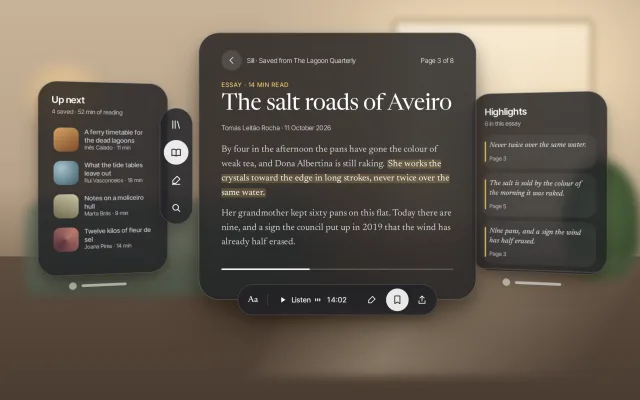
Three floating glass windows at different depths over a soft room-light scene, with ornament toolbars, a window that comes forward on focus, and gaze hover.
Preview
Use it
Free to use · credit appreciated1 Once, in your project · Node 22.20+
npx skills add SusanAcharya/Design-Lounge 2 Then ask
Using the Design Lounge skill, build "Spatial glass windows" (piece spatial-glass-windows) in my stack. Match its brief; restyle it onto my product's theme.
No skill? Paste the brief instead. It carries the numbers, tokens and behaviour.
<!-- Design Lounge Nº 599 · "Spatial glass windows" · www.designlounge.live -->

# Spatial glass windows

> **Build brief for a coding agent.** Rebuild this piece in the reader's stack. If they haven't said which stack, ask once, then default to semantic HTML + CSS + a little vanilla JS. Match the numbers below; don't "improve" them.

## What it is

A web page that borrows the spatial-computing window language: a reading app called Sill shown as three grey glass windows floating in a softly blurred living room at late-afternoon light. The main window holds an essay set in Newsreader; a vertical tab ornament hangs off its left edge and a pill toolbar ornament straddles its bottom edge. Two side windows (Up next, Highlights) sit further back and turned toward the viewer with `rotateY(±18deg)`. Hover, focus or click a window and it comes forward in Z with a deeper shadow. Every button carries a gaze-like highlight: a 70px soft white spot that follows the pointer inside the button. The detail worth copying: the glass is a dark 82% tint, not a pale frost, so white text stays above 4.5:1 over any part of the room, and a solid `#2F2F34` takes over where `backdrop-filter` is missing.

## Reference behaviour

1. Initial state at 1280×800: the room fills the viewport (warm wall, bright window pane top right, sofa left, plant right, floor from 64% height). The Reading window is in front (`.front`, `translateZ(46px)`), Up next sits left at `translateZ(-160px) rotateY(18deg)`, Highlights sits right at `translateZ(-110px) rotateY(-18deg)`.
2. The Reading window shows a top bar (40px round back button, source line "Sill · Saved from The Lagoon Quarterly", "Page 3 of 8"), a gold kicker "ESSAY · 14 MIN READ", the 44px title "The salt roads of Aveiro", a byline, two paragraphs with one highlighted sentence, and a 3px reading progress bar at 38%.
3. The vertical tab ornament (Library, Reading, Highlights, Search) floats 76px left of the Reading window, vertically centred. Reading is the current tab: a white 48px disc with dark icon. Hovering a tab shows its name in a dark pill 66px to its right, fading in and sliding 4px over 160ms.
4. The toolbar ornament straddles the Reading window's bottom edge (`bottom:-30px`): Aa, a 1px divider, Listen with a three-bar wave and "14:02", Highlight, Saved (pressed, white disc), Share.
5. Hovering any window (or tabbing into it, or pressing on it) moves it forward: Reading to `translateZ(46px)`, Up next to `translateZ(-40px) rotateY(12deg)`, Highlights to `translateZ(0) rotateY(-12deg)`, over 360ms on the sheet spring. Its shadow deepens. A click or focus makes that window the persistent `.front` one; the others go back to rest.
6. Moving the pointer over any button paints a radial white spot (26% alpha at centre, 70px radius) where the pointer is, plus a 10% white fill. Pressing scales the button to 0.96.
7. Listen, Highlight and Saved are toggles (`aria-pressed`). Pressed state is a 90% white fill with `#1D1D21` icon. When Listen is on, its three wave bars animate between 6px and 14px. Each toggle announces its new state through a polite live region ("Reading aloud", "Paused", "Saved to library").
8. Under each side window a window bar floats 26px below: a 96×6px pill with a 16px close dot to its left.
9. Below 900px wide the 3D stage flattens: windows stack in one column (Reading, Highlights, Up next) 56px apart, the tab ornament hides, the toolbar drops Share and the time label, and the page scrolls over a fixed room.

## Structure

```
1280 × 800  (perspective 1700px, origin 50% 40%)
┌──────────────────────────────────────────────────────────────────────────┐
│ room: wall gradient · window pane (62%,6%,30%×48%) · sofa · plant · floor │
│                                                                          │
│        ┌──────────────────────────────┐                                  │
│ ┌─────┐│ ◀  source line      Page 3/8 │┌─────────┐                       │
│ │Up   │●│ KICKER                       ││Highlights│                      │
│ │next │●│ The salt roads of Aveiro    ││ quote    │                      │
│ │rows │●│ byline                       ││ quote    │                      │
│ │ ×4  │●│ body 18/1.56, 452 max        ││ quote    │                      │
│ └─────┘ │ ─────── progress 38%         │└─────────┘                       │
│  ○──    └───[Aa | ▶ Listen 14:02 ✎ ▣ ⇪]─┘   ○──                           │
│                                                                          │
└──────────────────────────────────────────────────────────────────────────┘
 Up next 276×420 @ (30,150) · Reading 540×520 @ (404,72) · Highlights 280×384 @ (964,176)

… 178 more lines. Copy or download for the full brief. Loading the source…Brief
218 linesBuild brief for a coding agent. Rebuild this piece in the reader’s stack. If they haven’t said which stack, ask once, then default to semantic HTML + CSS + a little vanilla JS. Match the numbers below; don’t “improve” them.
What it is
A web page that borrows the spatial-computing window language: a reading app called Sill shown as three grey glass windows floating in a softly blurred living room at late-afternoon light. The main window holds an essay set in Newsreader; a vertical tab ornament hangs off its left edge and a pill toolbar ornament straddles its bottom edge. Two side windows (Up next, Highlights) sit further back and turned toward the viewer with rotateY(±18deg). Hover, focus or click a window and it comes forward in Z with a deeper shadow. Every button carries a gaze-like highlight: a 70px soft white spot that follows the pointer inside the button. The detail worth copying: the glass is a dark 82% tint, not a pale frost, so white text stays above 4.5:1 over any part of the room, and a solid #2F2F34 takes over where backdrop-filter is missing.
Reference behaviour
- Initial state at 1280×800: the room fills the viewport (warm wall, bright window pane top right, sofa left, plant right, floor from 64% height). The Reading window is in front (
.front,translateZ(46px)), Up next sits left attranslateZ(-160px) rotateY(18deg), Highlights sits right attranslateZ(-110px) rotateY(-18deg). - The Reading window shows a top bar (40px round back button, source line “Sill · Saved from The Lagoon Quarterly”, “Page 3 of 8”), a gold kicker “ESSAY · 14 MIN READ”, the 44px title “The salt roads of Aveiro”, a byline, two paragraphs with one highlighted sentence, and a 3px reading progress bar at 38%.
- The vertical tab ornament (Library, Reading, Highlights, Search) floats 76px left of the Reading window, vertically centred. Reading is the current tab: a white 48px disc with dark icon. Hovering a tab shows its name in a dark pill 66px to its right, fading in and sliding 4px over 160ms.
- The toolbar ornament straddles the Reading window’s bottom edge (
bottom:-30px): Aa, a 1px divider, Listen with a three-bar wave and “14:02”, Highlight, Saved (pressed, white disc), Share. - Hovering any window (or tabbing into it, or pressing on it) moves it forward: Reading to
translateZ(46px), Up next totranslateZ(-40px) rotateY(12deg), Highlights totranslateZ(0) rotateY(-12deg), over 360ms on the sheet spring. Its shadow deepens. A click or focus makes that window the persistent.frontone; the others go back to rest. - Moving the pointer over any button paints a radial white spot (26% alpha at centre, 70px radius) where the pointer is, plus a 10% white fill. Pressing scales the button to 0.96.
- Listen, Highlight and Saved are toggles (
aria-pressed). Pressed state is a 90% white fill with#1D1D21icon. When Listen is on, its three wave bars animate between 6px and 14px. Each toggle announces its new state through a polite live region (“Reading aloud”, “Paused”, “Saved to library”). - Under each side window a window bar floats 26px below: a 96×6px pill with a 16px close dot to its left.
- Below 900px wide the 3D stage flattens: windows stack in one column (Reading, Highlights, Up next) 56px apart, the tab ornament hides, the toolbar drops Share and the time label, and the page scrolls over a fixed room.
Structure
1280 × 800  (perspective 1700px, origin 50% 40%)
┌──────────────────────────────────────────────────────────────────────────┐
│ room: wall gradient · window pane (62%,6%,30%×48%) · sofa · plant · floor │
│                                                                          │
│        ┌──────────────────────────────┐                                  │
│ ┌─────┐│ ◀  source line      Page 3/8 │┌─────────┐                       │
│ │Up   │●│ KICKER                       ││Highlights│                      │
│ │next │●│ The salt roads of Aveiro    ││ quote    │                      │
│ │rows │●│ byline                       ││ quote    │                      │
│ │ ×4  │●│ body 18/1.56, 452 max        ││ quote    │                      │
│ └─────┘ │ ─────── progress 38%         │└─────────┘                       │
│  ○──    └───[Aa | ▶ Listen 14:02 ✎ ▣ ⇪]─┘   ○──                           │
│                                                                          │
└──────────────────────────────────────────────────────────────────────────┘
 Up next 276×420 @ (30,150) · Reading 540×520 @ (404,72) · Highlights 280×384 @ (964,176)
tab ornament: 64px wide column at Reading.left − 76 · toolbar: 60px tall, centred, bottom −30.room(aria-hidden,position:fixed): five<i>shapes, each blurred 6–10px, over a two-stop wall and floor gradient.<main class="stage">: the perspective container.<section class="win left" tabindex="0" aria-label="Up next window">:h2, count line, four<button class="row">with a 52px gradient cover tile, title and author line, then.grab.<article class="win main" tabindex="0" aria-label="Reading window">: top bar, kicker,h1, byline,.bodyparagraphs with one<mark>,role="progressbar", then<nav class="orn tabs" aria-label="Sections">and<div class="orn tool" role="toolbar">positioned against the article.<aside class="win right" aria-label="Highlights window">:h2, count, three.qquotes, a “Send to notebook” button,.grab.<p class="sr" aria-live="polite">for toggle announcements.
Tokens
:root {
  /* room */
  --wall: #b9a48c;          /* mid wall */
  --wall-top: #c7b399;      /* wall at the ceiling */
  --wall-2: #8f7b66;        /* wall at the skirting, page fallback */
  --floor: #5d4d40;         /* floor from 64.2% */
  --floor-2: #4a3d33;       /* floor at the bottom edge */
  --sun: #f1dcb8;           /* window light, radial at 78% 18% */
  /* glass */
  --glass: rgba(30,30,34,.82);      /* window tint */
  --glass-orn: rgba(36,36,40,.84);  /* ornament tint */
  --glass-solid: #2f2f34;           /* no-backdrop-filter fallback */
  --glass-hi: rgba(255,255,255,.16);/* 1px top inner highlight */
  --edge: rgba(255,255,255,.22);    /* 1px inner rim */
  --edge-front: rgba(255,255,255,.30);
  /* ink */
  --ink: #ffffff;           /* titles, labels */
  --ink-2: #dcdce2;         /* body, top bar */
  --ink-3: #cdcdd5;         /* meta lines */
  --mark: #f3c96a;          /* kicker, quote bars, highlight (at 20%) */
  --pressed-ink: #1d1d21;   /* icon on a pressed white disc */
  --tip: #2a2a2e;           /* tab tooltip */
  /* type */
  --ui: "Inter Tight", system-ui, sans-serif;
  --read: "Newsreader", Georgia, serif;
  --fs-title: 44px; --fs-body: 18px; --fs-ui: 14px; --fs-meta: 13px; --fs-small: 12px;
  /* space */
  --s-1: 4px; --s-2: 8px; --s-3: 12px; --s-4: 16px; --s-5: 22px; --s-6: 34px; --s-7: 44px;
  /* radii */
  --r-win: 40px; --r-row: 22px; --r-quote: 20px; --r-cover: 14px; --r-orn: 999px; --r-btn: 999px;
  /* shadows */
  --sh-win: 0 30px 60px -20px rgba(28,18,8,.55), 0 8px 18px rgba(28,18,8,.22);
  --sh-front: 0 50px 90px -24px rgba(28,18,8,.7), 0 14px 30px rgba(28,18,8,.3);
  --sh-orn: 0 16px 30px -10px rgba(20,12,4,.5);
  --blur-win: blur(36px) saturate(1.5);
  --blur-orn: blur(30px) saturate(1.5);
  /* motion */
  --ease: cubic-bezier(.2,.7,.2,1);
  --spring: cubic-bezier(.32,.72,0,1);
  --t: 360ms; --t-fast: 160ms; --t-wave: 900ms;
}
Typography
| Role | Family | Size | Weight | Line-height | Tracking | Case |
|---|---|---|---|---|---|---|
| Essay title | Newsreader (opsz 72) | 44px | 400 | 1.04 | −0.015em | sentence |
| Essay body | Newsreader | 18px | 400 | 1.56 | 0 | sentence |
| Quote | Newsreader italic | 15px | 400 | 1.4 | 0 | sentence |
| Kicker | Inter Tight | 12px | 500 | 1 | +0.08em | UPPERCASE |
| Window heading | Inter Tight | 20px | 600 | 1.2 | −0.01em | sentence |
| Toolbar label | Inter Tight | 14px | 500 | 1.4 | 0 | sentence |
| Row title | Inter Tight | 14px | 500 | 1.25 | 0 | sentence |
| Meta / byline | Inter Tight | 12–13px | 400 | 1.4 | 0 | sentence |
| “Aa” glyph | Newsreader | 17px | 500 | 1 | 0 | as set |
Motion
| Element | Trigger | Property | From → To | Duration | Easing |
|---|---|---|---|---|---|
.win.main | hover, focus-within, .front | transform | translateZ(0) → translateZ(46px) | 360ms | --spring |
.win.left | same | transform | Z(-160) rotY(18) → Z(-40) rotY(12) | 360ms | --spring |
.win.right | same | transform | Z(-110) rotY(-18) → Z(0) rotY(-12) | 360ms | --spring |
.win | same | box-shadow | --sh-win → --sh-front | 360ms | --ease |
.gz::after | hover | opacity | 0 → 1 (spot follows pointer) | 160ms | --ease |
.gz | active | transform | scale 1 → .96 | 160ms | --ease |
.tl tooltip | tab hover / focus-visible | opacity, translate | 0, −4px → 1, 0 | 160ms | --ease |
.wave i | Listen pressed | height | 6px ↔ 14px, alternate, staggered −300ms | 900ms | --ease |
Reduced motion: every transition is 1ms and the wave does not animate. Windows still change depth, instantly.
States
- Window at rest:
--glassfill, 1px--edgeinner rim, 1px--glass-hitop highlight,--sh-win. - Window forward (hover, focus-within,
.front): rim to--edge-front,--sh-front,z-index:5, transform per the motion table. - Window focus-visible: 2px inner white ring plus
--sh-front. - Button hover: 10% white fill plus the gaze spot.
- Button focus-visible: 2px white outline, 2px offset.
- Pressed / current: 90% white fill,
--pressed-inkicon and text. - Listen on: wave bars animate; live region says “Reading aloud”.
- No backdrop-filter: windows and ornaments switch to
--glass-solid.
Accessibility
- Each window is a landmark-like region with an
aria-labelandtabindex="0", so keyboard users can bring it forward by tabbing into it. - Tab ornament is a
<nav aria-label="Sections">; the current tab carriesaria-current="page"; icon-only buttons havearia-label. Tooltip text isaria-hiddenbecause the label already names the button. - Toolbar is
role="toolbar"witharia-label="Reading tools"; toggles usearia-pressed. - Progress uses
role="progressbar"witharia-valuenow="38". - Contrast:
--inkon the darkest wall composite is about 6.5:1;--ink-3meta on glass stays above 4.5:1 because the tint is 82%, not the common 40%. - Hit targets: toolbar buttons 44px tall, tab buttons 48px, side rows about 72px.
- Tab order: Up next rows, back button, essay, tabs, toolbar, Highlights.
Responsive rules
- ≥ 1280: as specified, three windows in perspective.
- 1024–1279: keep the layout and scale the stage with
transform: scale(calc(100vw / 1280px))from the top centre, or shrink side windows to 240px. - 900–1023: hide the Up next window; Reading and Highlights stay in 3D.
- < 900 (phones at 390): flatten.
perspective:none, windowsposition:relative, full width minus 16px gutters, stacked Reading, Highlights, Up next with a 56px gap so the toolbar and window bars have room. Corner radius drops to 32px, title to 32px, body to 17px. Tabs hide; toolbar keeps Aa, Listen, Highlight, Saved.
Acceptance checklist
Always
- Glass tint is at least 80% opaque, and a solid fallback is used when
backdrop-filteris unsupported. - Exactly one window is
.front; hover, focus-within or click moves a window forward in Z over 360ms with the spring curve. - The toolbar ornament straddles the main window’s bottom edge, half in and half out.
- Every button shows the pointer-following gaze spot on hover and a 2px white focus ring on keyboard focus.
- Toggles expose
aria-pressedand announce through a polite live region. - Body text is at least 4.5:1 against the composited glass at 1280 and 390.
- At 390 nothing scrolls sideways; windows stack in one column.
- Reduced motion removes transitions and the wave animation.
This demo
- Reading window is 540×520 at (404, 72); Up next 276×420 at (30, 150); Highlights 280×384 at (964, 176).
- Title reads “The salt roads of Aveiro” in Newsreader 44px; kicker “ESSAY · 14 MIN READ” in
#F3C96A. - Toolbar reads Aa, Listen 14:02, Highlight, Saved (pressed), Share.
- Highlights shows “6 in this essay” and three italic quotes with 3px gold bars.
Implementation notes
- The gaze spot. One delegated
pointermovewrites the pointer position into custom properties on whichever button is under it; CSS does the painting. Do not attach a listener per button.
.gz { position: relative; overflow: hidden; }
.gz::after {
  content: ""; position: absolute; inset: 0; border-radius: inherit;
  pointer-events: none; opacity: 0; transition: opacity 160ms var(--ease);
  background: radial-gradient(70px circle at var(--gx,50%) var(--gy,50%),
    rgba(255,255,255,.26), rgba(255,255,255,0) 70%);
}
.gz:hover::after { opacity: 1; }document.addEventListener('pointermove', e => {
const b = e.target.closest?.('.gz'); if (!b) return;
const r = b.getBoundingClientRect();
b.style.setProperty('--gx', e.clientX - r.left + 'px');
b.style.setProperty('--gy', e.clientY - r.top + 'px');
});- Depth without a 3D engine. Put
perspective:1700pxon the stage and give each window a restingtranslateZplusrotateY. The forward state is a selector list, so hover, keyboard focus and the clicked window share one rule. Raisez-indexon the forward window, because a negativetranslateZdoes not stop a later sibling painting on top.
.win { transition: transform 360ms var(--spring), box-shadow 360ms var(--ease); }
.left { transform: translateZ(-160px) rotateY(18deg); }
.left:is(:hover, :focus-within, .front) { transform: translateZ(-40px) rotateY(12deg); z-index: 5; }- Glass that passes contrast. The common mistake is a pale 30–40% frost; white text then fails over the bright window pane. Use a dark 82% tint and test the fallback:
.win { background: rgba(30,30,34,.82); backdrop-filter: blur(36px) saturate(1.5); }
@supports not ((backdrop-filter: blur(1px)) or (-webkit-backdrop-filter: blur(1px))) {
  .win, .orn { background: #2f2f34; }
}
Do not dim the back windows with filter: brightness() to fake depth: it drags their text under 4.5:1. Depth comes from Z, rotation and shadow only.
Details
- Palette
- Type
- Inter Tight · Newsreader
- Motion
- Subtle motion
- Build
- Multi-step
- Tags
Studied
Icon MuseumLet the icons be the only colour. Give each one a shelf, a lift on hover, and a quiet label.
All sourcesSimilar
Glass dashboard home
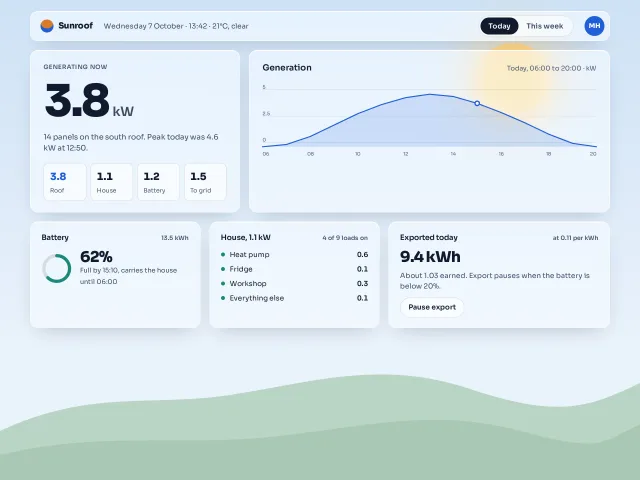
A home-energy dashboard as frosted panels over one drawn sky: a glass bar, an 88px live number, an SVG generation curve, a battery ring and a device list, with a solid fallback.
Liquid glass hero layers
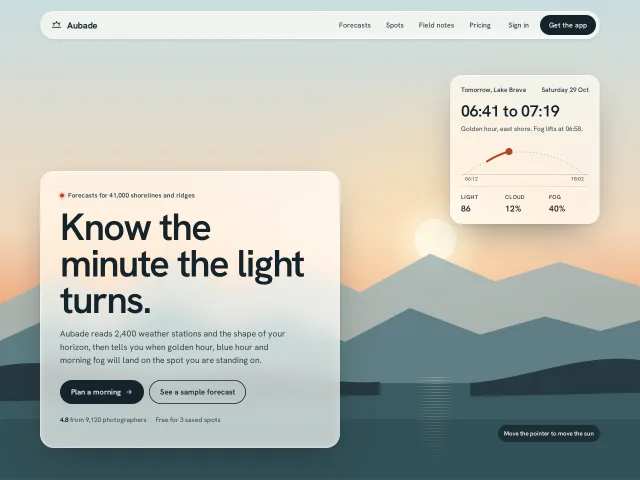
A dawn-lake hero with three frosted panels whose edge highlights turn toward a sun you move with the pointer, with solid fallbacks and 4.5:1 text on the blur.
Analytics dashboard overview
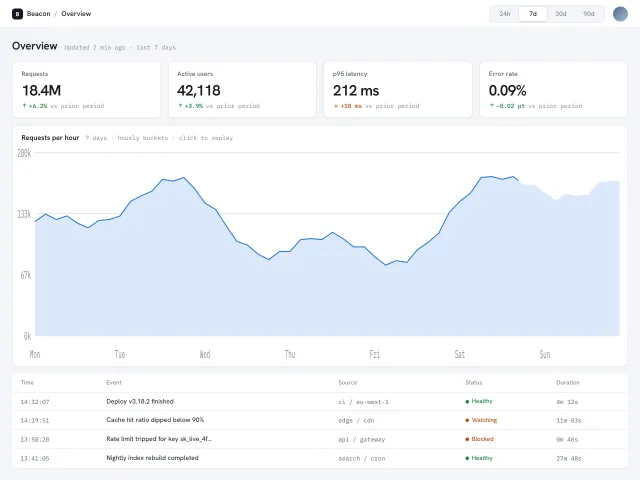
Light analytics overview: four KPI tiles, a single-series area chart drawn as inline SVG with an animated stroke, a crosshair tooltip, a recent-events table and a sliding date-range segmented control.
Fintech home
A banking home screen: dark balance card with a 40px tabular amount and a blur-to-hide toggle, four circular quick actions, day-grouped transactions with initial avatars, under a glass top bar.
Now playing
A full-screen player: CSS-gradient album art with SVG grain, the same art blurred as the backdrop, a scrubber with a fat drag thumb, a path-morphing play/pause and time-synced lyrics.
Onboarding carousel
Three snap-scrolled onboarding slides with CSS-drawn illustrations, page dots that stretch into a 24px pill, and a Continue button that becomes Get started on the last slide.