Nº 616 of 629
Hold-to-record voice note
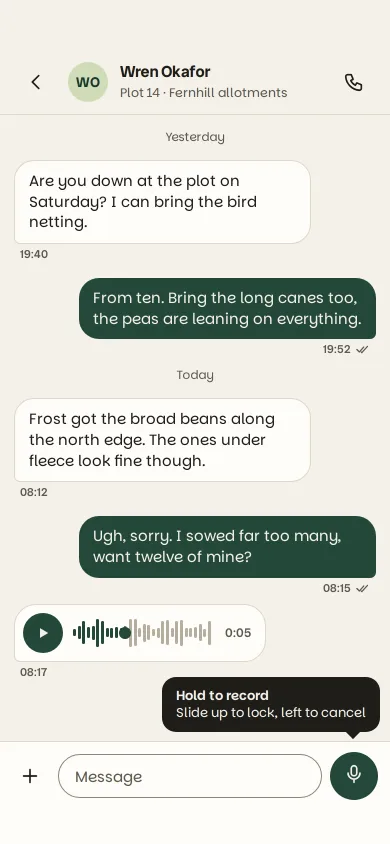
A chat composer mic you hold to record: it swells, a live waveform grows, slide left to bin the note or up to lock, release to send a scrubbable bubble.
Preview
Use it
Free to use · credit appreciated1 Once, in your project · Node 22.20+
npx skills add SusanAcharya/Design-Lounge 2 Then ask
Using the Design Lounge skill, build "Hold-to-record voice note" (piece voice-note-recorder) in my stack. Match its brief; restyle it onto my product's theme.
No skill? Paste the brief instead. It carries the numbers, tokens and behaviour.
<!-- Design Lounge Nº 616 · "Hold-to-record voice note" · www.designlounge.live -->

# Hold-to-record voice note

> **Build brief for a coding agent.** Rebuild this piece in the reader's stack. If they haven't said which stack, ask once, then default to semantic HTML + CSS + a little vanilla JS. Match the numbers below; don't "improve" them.

## What it is

The voice-note control in the chat composer of "Furrow", an invented messaging app for allotment neighbours, shown mid-conversation between you and Wren Okafor about frost-bitten broad beans. Press and hold the moss-green mic: it swells to 1.5× on a spring and turns vermilion, a live waveform grows from the left, a timer counts. Slide left and a bin fades in and eats the note; slide up past a lock pill and recording goes hands-free with Stop and Send; let go and the note lands in the thread as a bubble with a waveform you can play, drag to scrub, or step with arrow keys. The detail worth copying is that every gesture has a twin: Space on the mic records hands-free in the locked state, Escape discards, and the bubble's scrub knob is a real slider. The microphone is never requested; amplitude is simulated.

## Reference behaviour

1. First frame (390 × 844): a header with back, a "WO" avatar, "Wren Okafor / Plot 14 · Fernhill allotments", and call. The thread shows "Yesterday" with two messages, "Today" with two more, then Wren's 0:14 voice note paused 38% in (reads "0:05"). Composer: plus, a "Message" pill field, and a 48px moss mic. A dark tip above the mic reads "Hold to record / Slide up to lock, left to cancel".
2. Pointer down (primary only) on the mic: pointer capture, state `hold`. The mic scales 1 → 1.5 with a 420ms overshoot spring and turns `#C23B26`; a halo ring around it breathes with the amplitude (0–14px). The tip hides for good.
3. In `hold` the composer row is covered by a recording strip: pulsing red dot, timer "0:00", live waveform, and "‹ Slide to cancel". A 40 × 92px lock pill rises 14px into view above the mic with a lock and a bobbing up-chevron.
4. Every 90ms a new bar is appended (3px wide, 2px gap, height 3 + amplitude × 25px), growing in from 20% height over 140ms. When the strip is full the oldest bar is removed, so the wave scrolls left.
5. After 8px of travel the drag locks to one axis. The mic follows the finger at 0.9× along that axis only (left or up; right and down clamp to 0).
6. Sliding left: `--cx` = distance / 110px. The "Slide to cancel" label moves left by `cx × 92px` and fades (`1 − cx × 1.15`); a red bin grows from 0.6 to 1.1 scale at the strip's left. At 110px the note is discarded: the dot hops in an arc into the bin (420ms), the lid opens 38° and closes (640ms), and the bin sinks 10px and fades (900ms total). Announce "Voice note discarded."
7. Sliding up: `--ly` = distance / 80px. The lock shackle closes 3px and the chevron fades. At 80px the state becomes `locked`: the mic springs back to its seat (380ms), shrinks to 1×, turns moss and shows a send arrow. The strip shows bin, dot, a small closed lock, timer, wave, and a 40px Stop button.
8. Releasing in `hold` after at least 350ms sends. A release under 350ms is a tap: discard silently, re-show the tip with a 420ms wiggle, and announce "Hold to record. Or press Space to record hands-free."
9. Send: the samples are bucketed into 30 bars (max per bucket) and a moss bubble appears at the end of the thread, rising 22px and scaling .92 → 1 over 420ms, timestamp 08:24 (then 08:25…), with a sent tick. The thread scrolls to the bottom.
10. Locked: Stop freezes the strip into a draft (grey dot and bars, no Stop button). Send (the mic) sends; the bin discards with the same animation; Escape discards from `hold`, `locked` or `draft`.
11. Keyboard: Space or Enter on the focused mic starts recording straight into `locked`, and focus stays on the same button, now labelled "Send voice note". Pressing it again sends.
12. Voice bubbles: a 40px play button and a waveform. Play runs a rAF clock at real time; the played part fills from the left with a clip, a 12px knob rides the edge, and the time shows the position. At the end it resets to 0 and shows the duration. Only one note plays at a time; recording pauses playback.
13. Scrubbing: pointer down anywhere on the wave captures the pointer and seeks; dragging scrubs. The knob is the slider: Left/Right ±1s, PageUp/PageDown ±5s, Home, End, Space plays or pauses.
14. Reduced motion: no animations or springs; the hold scale is 1.2 instead of 1.5; discard resets after 200ms with no bin animation; bubbles appear in place.

## Structure

```
390 × 844 (app column max 440px, centred on #E6E1D5 above that)
┌──────────────────────────────────────┐
│ 54px clear for status bar            │
│ (‹) (WO) Wren Okafor          (call) │ header, 62px top pad, 1px rule
│          Plot 14 · Fernhill …        │
├──────────────────────────────────────┤
│            Yesterday                 │ thread: flex column, scrolls,
│ [incoming 82%]                       │ first child margin-top:auto
│                  [outgoing moss 82%] │
│            Today                     │

… 188 more lines. Copy or download for the full brief. Loading the source…Brief
228 linesBuild brief for a coding agent. Rebuild this piece in the reader’s stack. If they haven’t said which stack, ask once, then default to semantic HTML + CSS + a little vanilla JS. Match the numbers below; don’t “improve” them.
What it is
The voice-note control in the chat composer of “Furrow”, an invented messaging app for allotment neighbours, shown mid-conversation between you and Wren Okafor about frost-bitten broad beans. Press and hold the moss-green mic: it swells to 1.5× on a spring and turns vermilion, a live waveform grows from the left, a timer counts. Slide left and a bin fades in and eats the note; slide up past a lock pill and recording goes hands-free with Stop and Send; let go and the note lands in the thread as a bubble with a waveform you can play, drag to scrub, or step with arrow keys. The detail worth copying is that every gesture has a twin: Space on the mic records hands-free in the locked state, Escape discards, and the bubble’s scrub knob is a real slider. The microphone is never requested; amplitude is simulated.
Reference behaviour
- First frame (390 × 844): a header with back, a “WO” avatar, “Wren Okafor / Plot 14 · Fernhill allotments”, and call. The thread shows “Yesterday” with two messages, “Today” with two more, then Wren’s 0:14 voice note paused 38% in (reads “0:05”). Composer: plus, a “Message” pill field, and a 48px moss mic. A dark tip above the mic reads “Hold to record / Slide up to lock, left to cancel”.
- Pointer down (primary only) on the mic: pointer capture, state
hold. The mic scales 1 → 1.5 with a 420ms overshoot spring and turns#C23B26; a halo ring around it breathes with the amplitude (0–14px). The tip hides for good. - In
holdthe composer row is covered by a recording strip: pulsing red dot, timer “0:00”, live waveform, and ”‹ Slide to cancel”. A 40 × 92px lock pill rises 14px into view above the mic with a lock and a bobbing up-chevron. - Every 90ms a new bar is appended (3px wide, 2px gap, height 3 + amplitude × 25px), growing in from 20% height over 140ms. When the strip is full the oldest bar is removed, so the wave scrolls left.
- After 8px of travel the drag locks to one axis. The mic follows the finger at 0.9× along that axis only (left or up; right and down clamp to 0).
- Sliding left:
--cx= distance / 110px. The “Slide to cancel” label moves left bycx × 92pxand fades (1 − cx × 1.15); a red bin grows from 0.6 to 1.1 scale at the strip’s left. At 110px the note is discarded: the dot hops in an arc into the bin (420ms), the lid opens 38° and closes (640ms), and the bin sinks 10px and fades (900ms total). Announce “Voice note discarded.” - Sliding up:
--ly= distance / 80px. The lock shackle closes 3px and the chevron fades. At 80px the state becomeslocked: the mic springs back to its seat (380ms), shrinks to 1×, turns moss and shows a send arrow. The strip shows bin, dot, a small closed lock, timer, wave, and a 40px Stop button. - Releasing in
holdafter at least 350ms sends. A release under 350ms is a tap: discard silently, re-show the tip with a 420ms wiggle, and announce “Hold to record. Or press Space to record hands-free.” - Send: the samples are bucketed into 30 bars (max per bucket) and a moss bubble appears at the end of the thread, rising 22px and scaling .92 → 1 over 420ms, timestamp 08:24 (then 08:25…), with a sent tick. The thread scrolls to the bottom.
- Locked: Stop freezes the strip into a draft (grey dot and bars, no Stop button). Send (the mic) sends; the bin discards with the same animation; Escape discards from
hold,lockedordraft. - Keyboard: Space or Enter on the focused mic starts recording straight into
locked, and focus stays on the same button, now labelled “Send voice note”. Pressing it again sends. - Voice bubbles: a 40px play button and a waveform. Play runs a rAF clock at real time; the played part fills from the left with a clip, a 12px knob rides the edge, and the time shows the position. At the end it resets to 0 and shows the duration. Only one note plays at a time; recording pauses playback.
- Scrubbing: pointer down anywhere on the wave captures the pointer and seeks; dragging scrubs. The knob is the slider: Left/Right ±1s, PageUp/PageDown ±5s, Home, End, Space plays or pauses.
- Reduced motion: no animations or springs; the hold scale is 1.2 instead of 1.5; discard resets after 200ms with no bin animation; bubbles appear in place.
Structure
390 × 844 (app column max 440px, centred on #E6E1D5 above that)
┌──────────────────────────────────────┐
│ 54px clear for status bar            │
│ (‹) (WO) Wren Okafor          (call) │ header, 62px top pad, 1px rule
│          Plot 14 · Fernhill …        │
├──────────────────────────────────────┤
│            Yesterday                 │ thread: flex column, scrolls,
│ [incoming 82%]                       │ first child margin-top:auto
│                  [outgoing moss 82%] │
│            Today                     │
│ [incoming]                           │
│                  [outgoing]          │
│ [(▶) ▌▍▌▎▍●▏▏▏▏▏  0:05 ]  252px     │ voice bubble
│                 ┌───────────────┐    │
│                 │Hold to record │ tip│ 78px thread bottom pad while tip shows
│                 └──────────── v─┘    │
├──────────────────────────────────────┤
│ (+) ( Message                ) (mic) │ grid 40 / 1fr / 48, gap 8
│                                      │ padding 10 12 44 10
└──────────────────────────────────────┘
Hold:   [bin][●][0:03][▌▍▌▎▍▌  ][‹ Slide to cancel]  (MIC 72)
                                                  [lock pill 40×92 above mic]
Locked: [bin][●][lock][0:07][▌▍▌▎▍▌▍▌▎▍ ][■] (send 48)headerwith two iconbuttons (40px) and the contact name.main.threadwitharia-label="Messages with Wren Okafor"; each message adiv.msg.in|outholdingpor.note, and a.metatime..note:button.play,div.wave(twoaria-hiddenbar layers and aspan.knob role="slider"),span.dur(aria-hidden)..composercarriesdata-s= "" | hold | locked | draft | bin. Inside: tip, lock pill (aria-hidden), attachbutton,input.field,div.recstrip (absolute over the first two columns,visibility:hiddenwhen idle),button.mic.- One visually hidden
p aria-live="polite".
Tokens
:root {
  --page: #e6e1d5;      /* outside the app column */
  --app: #f4f1e9;       /* thread ground */
  --card: #fffdf8;      /* incoming bubble, composer */
  --ink: #1e1d19;
  --ink-2: #5c5950;     /* meta, placeholder, hints ~6.2:1 on --app */
  --line: #ded8ca;      /* hairlines, incoming bubble border */
  --edge: #8c877a;      /* message field border 3.4:1 on --card */
  --moss: #24483a;      /* mic, outgoing bubbles, play */
  --moss-2: #1a382c;    /* mic hover */
  --on-moss: #f4f0e6;   /* text on moss 9.6:1 */
  --meta-moss: #b9c7bc;
  --rec: #c23b26;       /* recording, bin, stop */
  --rec-halo: rgba(194,59,38,.16);
  --bar: #b5ae9e;       /* unplayed bars, incoming */
  --bar-moss: #6f8a7c;  /* unplayed bars, outgoing */
  --sprout: #cfdcb8;    /* avatar disc */
  --tip: #1e1d19;
  --sans: "Parkinsans", system-ui, sans-serif;
  --num: "Radio Canada Big", system-ui, sans-serif;
  --r-bubble: 20px; --r-bubble-tail: 6px; --r-note: 22px; --r-field: 22px; --r-tip: 14px;
  --ease: cubic-bezier(.2,.7,.2,1);
  --spring: cubic-bezier(.34,1.56,.64,1);   /* mic swell and return */
  --soft: cubic-bezier(.34,1.3,.64,1);      /* lock pill, bubble arrival */
  --t-swell: 420ms; --t-return: 380ms; --t-tick: 90ms; --t-bar: 140ms; --t-bin: 900ms;
  --cancel: 110px; --lock: 80px; --tap: 350ms;
}
Spacing: 2, 4, 6, 8, 10, 12, 14, 16, 18. Shadow (lock pill only): 0 6px 18px rgba(30,29,25,.12).
Typography
| Role | Family | Size | Weight | Line height | Notes |
|---|---|---|---|---|---|
| Contact name | Radio Canada Big | 16px | 600 | 1.2 | −0.01em |
| Avatar initials | Radio Canada Big | 14px | 600 | — | — |
| Status line | Parkinsans | 12.5px | 400 | 1.4 | --ink-2 |
| Message text, field | Parkinsans | 15px | 400 | 1.38 | — |
| Day divider, hint label | Parkinsans | 12–13.5px | 400 | — | --ink-2 |
| Times, durations | Radio Canada Big | 11.5–12.5px | 500 | — | no tabular figures (the colon gaps) |
| Recording timer | Radio Canada Big | 15px | 600 | — | min-width 36px |
| Tip | Parkinsans | 13px | 600 / 400 | 1.35 | two lines |
Motion
| Thing | Trigger | Property | From → to | Duration | Easing | Reduced motion |
|---|---|---|---|---|---|---|
| Mic swell | hold | scale, background | 1 → 1.5, moss → #C23B26 | 420 / 160ms | —spring / —ease | scale 1.2, instant |
| Amplitude halo | each tick | box-shadow spread | 0–14px | 90ms | linear | same |
| Mic follow | drag | translate | finger × 0.9 | 0 | — | same |
| Mic return | lock, release | translate | → 0 | 380ms | —spring | instant |
| Live bar | tick | scale Y | .2 → 1 | 140ms | —ease | none |
| Recording dot | recording | opacity | 1 → .35 → 1 | 1100ms loop | —ease | static |
| Cancel label | drag left | translate, opacity | 0 → −92px, 1 → 0 | 0 | — | same |
| Lock pill | hold | opacity, translate | 0 → 1, 14px → 0 | 180 / 320ms | —soft | instant |
| Discard | 110px or bin | dot arc, lid rotate, bin sink | see Reference 6 | 420 / 640 / 900ms | expo-ish | reset after 200ms |
| Bubble arrival | send | translate, scale, opacity | 22px .92 0 → 0 1 1 | 420ms | —soft | none |
| Tip wiggle | short tap | scale | 1 → 1.06 → .98 → 1 | 420ms | —spring | none |
States
- Mic idle: moss; hover
--moss-2; focus-visible 2.5px#C23B26outline, offset 3px. - Hold: red, 1.5×, halo; strip shows dot, timer, wave, cancel label; lock pill visible.
- Locked: mic is moss Send (paper plane, 16px filled); strip shows bin, dot, closed lock icon, timer, wave, Stop (40px ring, red 1.5px border, red square).
- Draft: dot and bars
--ink-2, Stop hidden, dot still. - Bin: timer and wave fade in 200ms while the bin plays.
- Voice bubble playing: pause icon; knob scales 1.25 on hover or focus.
- Message field focus: border becomes
--moss.
Accessibility
- The mic is one
buttonwhosearia-labelflips “Record voice note” ↔ “Send voice note”;aria-describedbypoints to the tip. - Space/Enter on the mic records hands-free (locked) so keyboard users never need to hold. Escape discards. Stop and the bin are real buttons inside the strip, in tab order only while recording.
- A click after a pointer hold is swallowed (
skipflag) so a release never double-sends; keyboard clicks havedetail === 0. - Live region messages: “Recording. Release to send.”, “Locked, recording hands-free…”, “Stopped at 0:07. Send or discard.”, “Voice note sent, 0:07.”, “Voice note discarded.”
- The knob is
role="slider"witharia-valuemin 0,aria-valuemax= duration seconds,aria-valuenow,aria-valuetext“0:05 of 0:14”. - Contrast: body text 15:1, meta 6.2:1 on
--app, outgoing text 9.6:1, field edge 3.4:1, tip text 15:1. - Hit targets: mic 48px, play 40px, stop and bin 40px, knob 12px drawn inside a 34px-tall scrub area.
touch-action: noneon the mic and on every wave so the thread never scrolls during a gesture.
Responsive rules
- At 360 wide the composer grid holds; the strip shrinks the wave first (it is
flex:1; min-width:0). - The app column is
max-width: 440px, centred; above that the page is#E6E1D5with a 1px--lineedge. - Bubbles are max 82% wide; voice bubbles are a fixed 252px.
- Tablet: keep the column, never stretch the composer past 440px.
Acceptance checklist
Always
- Pointer down records immediately; the mic swells on a spring and the waveform grows from the left.
- Release after ≥ 350ms sends; a shorter tap discards silently and re-shows the hint.
- Sliding left past the cancel distance discards with a bin animation and an announcement.
- Sliding up past the lock distance locks, returns the mic to its seat, and shows Stop and Send.
- The drag locks to one axis after 8px.
- Space/Enter on the mic starts a locked recording; pressing again sends; Escape discards.
- Sent notes become bubbles whose waveform is built from the recorded samples.
- Bubble playback fills the played part; drag and arrow keys scrub; the knob is a slider.
- No microphone permission is ever requested in the demo.
- Reduced motion removes springs and the bin animation and stays fully usable.
This demo
- Furrow thread with Wren Okafor, “Plot 14 · Fernhill allotments”, Wren’s note 0:14 paused at 0:05.
- Mic
#24483A48px → 1.5×#C23B26; cancel 110px, lock 80px, tick 90ms. - Tip “Hold to record / Slide up to lock, left to cancel”.
- New notes stamped 08:24, 08:25 and so on.
Implementation notes
One pointer session, three exits. Capture on down; move decides cancel or lock; up sends only if still holding:
mic.addEventListener('pointerdown', e => {
  if (e.button || state !== 'idle') return;
  mic.setPointerCapture(e.pointerId);
  sess = { x: e.clientX, y: e.clientY, ax: null, t: performance.now() };
  start('hold');
});
mic.addEventListener('pointermove', e => {
  if (!sess || state !== 'hold') return;
  let dx = Math.min(0, e.clientX - sess.x), dy = Math.min(0, e.clientY - sess.y);
  if (!sess.ax && Math.hypot(dx, dy) > 8) sess.ax = Math.abs(dx) > Math.abs(dy) ? 'x' : 'y';
  if (sess.ax !== 'x') dx = 0; if (sess.ax !== 'y') dy = 0;
  mic.style.translate = dx * .9 + 'px ' + dy * .9 + 'px';
  comp.style.setProperty('--cx', Math.min(1, -dx / 110));
  comp.style.setProperty('--ly', Math.min(1, -dy / 80));
  if (-dx >= 110) discard(); else if (-dy >= 80) lock();
});
mic.addEventListener('pointerup', () => {
  if (!sess) return; skip = true;
  const short = performance.now() - sess.t < 350; sess = null;
  if (state === 'hold') short ? (reset(), nudge()) : send();
});
Separate scale and translate. Use the individual CSS properties so the swell can spring while the follow tracks the finger with no transition. In hold, leave translate out of the transition list; outside hold, transition it with the spring so the mic flies home:
.mic { transition: scale 420ms var(--spring), translate 380ms var(--spring), background-color 160ms var(--ease); }
[data-s=hold] .mic { scale: 1.5; background: var(--rec);
  transition: scale 420ms var(--spring), background-color 160ms var(--ease), box-shadow 90ms linear; }
Played fill without per-bar work. Render the bars twice and clip the top copy to --p; the knob sits at left: calc(var(--p) * 100%):
.bars.top { clip-path: inset(0 calc(100% - var(--p) * 100%) 0 0); }Common mistakes:
- Asking for the microphone in a demo; simulate amplitude with a syllable-shaped function plus jitter.
- Acting on
clickafter a hold (it fires afterpointerupand double-sends once locked). - Letting the mic follow diagonally; it reads as loose. Lock the axis.
- Forgetting
touch-action: none, so the thread scrolls under the thumb. - Keyboard users stuck with “hold”: give them the locked state directly.
Details
- Palette
- Type
- Parkinsans · Radio Canada Big
- Motion
- Rich motion
- Build
- Multi-step
- Tags
Similar
Hold and slide to confirm
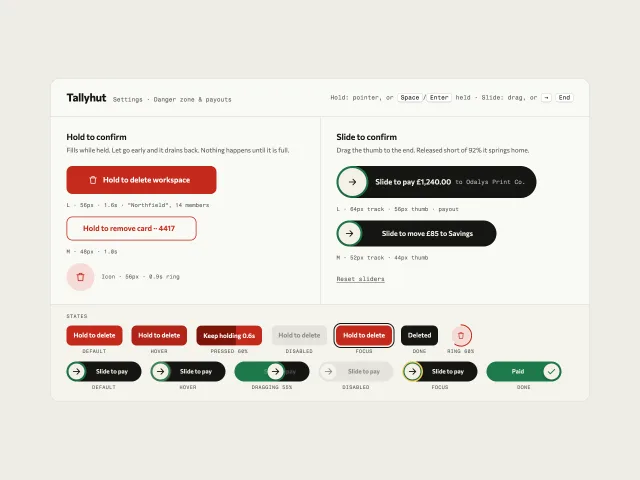
Hold-to-delete buttons that fill while held and drain on release, plus slide-to-pay tracks that spring home short of 92%, all with keyboard paths.
Liquid squish toggles
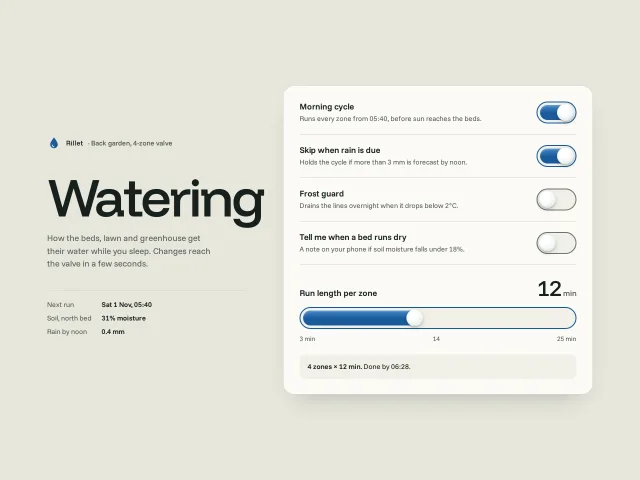
Switches whose knob is a soft droplet: it squashes on press, stretches as it travels, pours water into the track behind it and wobbles on arrival.
Drag to crop a profile photo
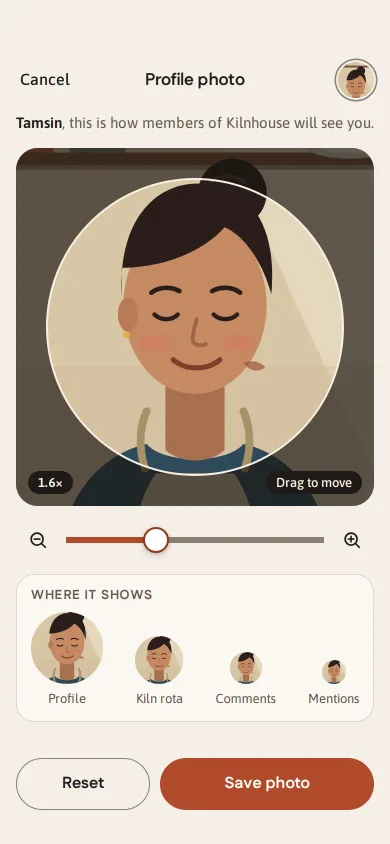
A circular crop for a pottery studio's member app: drag with momentum, pinch or wheel zoom around the pointer, rubber-band edges and live avatar previews.
Reaction burst picker
Hold the react button, slide across six hand-drawn faces that swell under your finger, let go: the face flies home, bursts, and the count rolls.
Island live activities
A black pill at the top of the screen that springs between a timer, a food order and a call, splits in two, and grows into a card with controls.
Slide to pay back a friend
A gold handle you drag along an ink track to repay a friend: letters dim as it passes, it resists near the end, snaps through at 90% and becomes a receipt.