Nº 636 of 677
Pair recall memory game
A 4 × 4 picnic-themed memory match you can play to the end: 3D card flips, a pop on a pair, a shake on a miss, stars by moves and a reshuffle.
Preview
Use it
Free to use · credit appreciated1 Once, in your project · Node 22.20+
npx skills add SusanAcharya/Design-Lounge 2 Then ask
Using the Design Lounge skill, build "Pair recall memory game" (piece minigame-pair-recall) in my stack. Match its brief; restyle it onto my product's theme.
No skill? Paste the brief instead. It carries the numbers, tokens and behaviour.
<!-- Design Lounge Nº 636 · "Pair recall memory game" · www.designlounge.live -->

# Pair recall memory game

> **Build brief for a coding agent.** Rebuild this piece in the reader's stack. If they haven't said which stack, ask once, then default to semantic HTML + CSS + a little vanilla JS. Match the numbers below; don't "improve" them.

## What it is

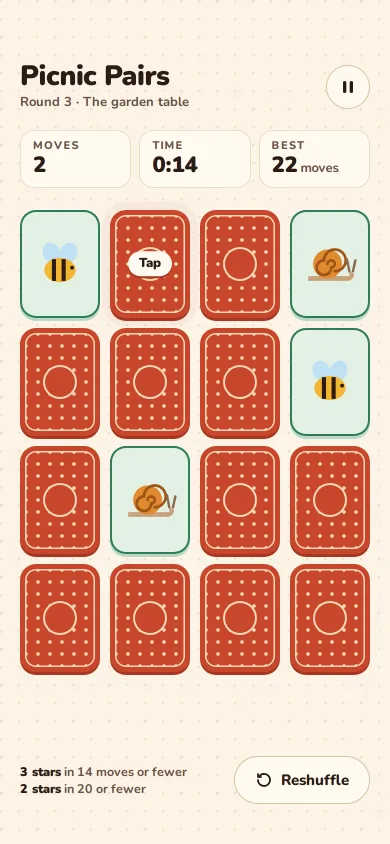
**Picnic Pairs**, an invented memory-match game on a cream picnic cloth: sixteen cards in a 4 × 4 grid hide eight original illustrated motifs (bee, pear, tulip, snail, strawberry, teapot, watering can, mushroom), each drawn from three to six flat SVG shapes. Card backs are persimmon with a cream dot weave, a stitched inner rule and a ring in the middle, sitting on a 3px darker "thickness" shadow so they read as card stock. The screen opens mid-round: two pairs already found and settled in mint, one card carrying a single word, "Tap", that pulses until the first touch. A pair pops with squash-and-stretch after a 40ms hit-stop and throws seven small gold sparks; a miss shakes both cards and flips them back. Stars are awarded by moves and arrive one at a time on the win panel, followed by a count-up and then the buttons. Custom game UI with Material-style big pill buttons.

## Reference behaviour

1. First frame: Moves 2, Time 0:14 (held), Best 22 moves. Bee (cards 1 and 8) and snail (cards 4 and 10) are face up and matched. Card 2 shows the "Tap" pill and a 9px pulsing ring on a 1.6s loop; it holds the roving tab stop.
2. First flip starts the timer (a `requestAnimationFrame` loop adding capped frame time, ≤ 100ms per frame). The ghost pill and pulse are removed for the rest of the round.
3. Tap or Enter on a face-down card: it turns `rotateY(180deg)` in 420ms (expo-out) to its face. Tapping a face-up, matched or locked card does nothing.
4. Second card of a turn: Moves goes up by one and input locks.
5. Match: after 420ms (the second flip finishing) both cards gain the matched style (mint ground, 2px green inner rule), wait a 40ms hit-stop, then pop: scale 1 → 1.13 × 1.07 → .97 × 1.02 → 1 in 380ms on a spring. Seven 7px gold dots fly out radially (52px × 58px ellipse) and fade in 520ms. Input unlocks. Live region: "Match: pear. 3 of 8."
6. Miss: at 520ms both cards shake (±6, ±6, ±4, ±3px over 360ms); at 980ms they flip back down and input unlocks. Live region: "No match: tulip and strawberry."
7. Pause (44px button top right, or P / Escape): the timer loop stops, a 55% scrim fades in (240ms) and a panel rises 24px (420ms): "Paused", "3 of 8 pairs found · 0:15", Reshuffle and Resume. Resume restarts the loop from the current time. Switching away from the tab also pauses.
8. Win (eighth pair): the loop stops 650ms after the last pop; the win panel opens. Stars: three for ≤ 14 moves, two for ≤ 20, otherwise one. Star 1 pops at 320ms, star 2 (the larger middle star, 64px) at 580ms, star 3 at 840ms; unearned stars land in `--star-off`. At 1,180ms the Moves / Time / Best row fades in and counts up from zero over 600ms. At 1,900ms the buttons fade in and "Play again" takes focus.
9. A new best (fewer moves than 22) updates Best in the header and the panel says "New best. 9 moves."
10. Reshuffle / Play again: Fisher–Yates shuffle of the 16 cards, Moves 0, Time 0:00, timer held until the first flip, ghost on card 1, focus on card 1. "See board" closes the win panel and leaves the solved board in view.

## Structure

```
390 × 844 (54px top, 34px bottom clear)
┌──────────────────────────────────────┐
│ 54px safe area                       │
│ Picnic Pairs                    (❚❚) │ 28px / 900, pause 44px circle
│ Round 3 · The garden table           │
│ ┌ MOVES ─┐ ┌ TIME ──┐ ┌ BEST ────┐   │ 3 equal stat tiles, gap 8, radius 14
│ │ 2      │ │ 0:14   │ │ 22 moves │   │ value 22px / 900
│ └────────┘ └────────┘ └──────────┘   │
│ ┌────┐ ┌────┐ ┌────┐ ┌────┐          │ board: 4 × 80px columns,
│ │bee │ │Tap │ │    │ │snl │          │ 108px rows, gap 10, centred
│ └────┘ └────┘ └────┘ └────┘          │ perspective 900px
│ ┌────┐ ┌────┐ ┌────┐ ┌────┐          │
│ │    │ │    │ │    │ │bee │          │
│ └────┘ └────┘ └────┘ └────┘          │

… 181 more lines. Copy or download for the full brief. Loading the source…Brief
221 linesBuild brief for a coding agent. Rebuild this piece in the reader’s stack. If they haven’t said which stack, ask once, then default to semantic HTML + CSS + a little vanilla JS. Match the numbers below; don’t “improve” them.
What it is
Picnic Pairs, an invented memory-match game on a cream picnic cloth: sixteen cards in a 4 × 4 grid hide eight original illustrated motifs (bee, pear, tulip, snail, strawberry, teapot, watering can, mushroom), each drawn from three to six flat SVG shapes. Card backs are persimmon with a cream dot weave, a stitched inner rule and a ring in the middle, sitting on a 3px darker “thickness” shadow so they read as card stock. The screen opens mid-round: two pairs already found and settled in mint, one card carrying a single word, “Tap”, that pulses until the first touch. A pair pops with squash-and-stretch after a 40ms hit-stop and throws seven small gold sparks; a miss shakes both cards and flips them back. Stars are awarded by moves and arrive one at a time on the win panel, followed by a count-up and then the buttons. Custom game UI with Material-style big pill buttons.
Reference behaviour
- First frame: Moves 2, Time 0:14 (held), Best 22 moves. Bee (cards 1 and 8) and snail (cards 4 and 10) are face up and matched. Card 2 shows the “Tap” pill and a 9px pulsing ring on a 1.6s loop; it holds the roving tab stop.
- First flip starts the timer (a
requestAnimationFrameloop adding capped frame time, ≤ 100ms per frame). The ghost pill and pulse are removed for the rest of the round. - Tap or Enter on a face-down card: it turns
rotateY(180deg)in 420ms (expo-out) to its face. Tapping a face-up, matched or locked card does nothing. - Second card of a turn: Moves goes up by one and input locks.
- Match: after 420ms (the second flip finishing) both cards gain the matched style (mint ground, 2px green inner rule), wait a 40ms hit-stop, then pop: scale 1 → 1.13 × 1.07 → .97 × 1.02 → 1 in 380ms on a spring. Seven 7px gold dots fly out radially (52px × 58px ellipse) and fade in 520ms. Input unlocks. Live region: “Match: pear. 3 of 8.”
- Miss: at 520ms both cards shake (±6, ±6, ±4, ±3px over 360ms); at 980ms they flip back down and input unlocks. Live region: “No match: tulip and strawberry.”
- Pause (44px button top right, or P / Escape): the timer loop stops, a 55% scrim fades in (240ms) and a panel rises 24px (420ms): “Paused”, “3 of 8 pairs found · 0:15”, Reshuffle and Resume. Resume restarts the loop from the current time. Switching away from the tab also pauses.
- Win (eighth pair): the loop stops 650ms after the last pop; the win panel opens. Stars: three for ≤ 14 moves, two for ≤ 20, otherwise one. Star 1 pops at 320ms, star 2 (the larger middle star, 64px) at 580ms, star 3 at 840ms; unearned stars land in
--star-off. At 1,180ms the Moves / Time / Best row fades in and counts up from zero over 600ms. At 1,900ms the buttons fade in and “Play again” takes focus. - A new best (fewer moves than 22) updates Best in the header and the panel says “New best. 9 moves.”
- Reshuffle / Play again: Fisher–Yates shuffle of the 16 cards, Moves 0, Time 0:00, timer held until the first flip, ghost on card 1, focus on card 1. “See board” closes the win panel and leaves the solved board in view.
Structure
390 × 844 (54px top, 34px bottom clear)
┌──────────────────────────────────────┐
│ 54px safe area                       │
│ Picnic Pairs                    (❚❚) │ 28px / 900, pause 44px circle
│ Round 3 · The garden table           │
│ ┌ MOVES ─┐ ┌ TIME ──┐ ┌ BEST ────┐   │ 3 equal stat tiles, gap 8, radius 14
│ │ 2      │ │ 0:14   │ │ 22 moves │   │ value 22px / 900
│ └────────┘ └────────┘ └──────────┘   │
│ ┌────┐ ┌────┐ ┌────┐ ┌────┐          │ board: 4 × 80px columns,
│ │bee │ │Tap │ │    │ │snl │          │ 108px rows, gap 10, centred
│ └────┘ └────┘ └────┘ └────┘          │ perspective 900px
│ ┌────┐ ┌────┐ ┌────┐ ┌────┐          │
│ │    │ │    │ │    │ │bee │          │
│ └────┘ └────┘ └────┘ └────┘          │
│ (rows 3 and 4)                       │
│ 3 stars in 14 moves or fewer  [↻ Reshuffle] │ foot, margin-top auto, pill 48px
│ 34px home indicator                  │
└──────────────────────────────────────┘
Layers: absolute inset 0, panel docked bottom with 16px sides and 34px bottom padding.<header>:<h1>, sub line, pause<button aria-label="Pause">..stats: three tiles, each<small>label and<b>value..board(role="group"with an instruction label): 16 ×.cell→<button class="card">with.b(back) and.f(face, holding<svg><use href="#motif">)..foot: star thresholds text and the Reshuffle pill.- Two
.layerdialogs (pause, win) and a visually hiddenaria-live="polite"line.
Tokens
:root {
  /* colour */
  --bg: #fbf3e6;        /* picnic cloth */
  --cloth-dot: #efe1cb; /* 18px dot weave on the cloth */
  --ink: #2b1b14;       /* text, primary button, focus */
  --ink-2: #6b5246;     /* labels, secondary text */
  --line: #ecdcc4;      /* tile borders, face rule */
  --chip: #fffaf1;      /* tiles, secondary buttons */
  --chip-line: #d9c4a6; /* 1.5px button border */
  --back: #c8462b;      /* card back */
  --back-2: #a83621;    /* card thickness shadow */
  --dot: #f6d9b8;       /* back weave and stitched rule */
  --face: #fffaf1;      /* card face */
  --ok: #2f7d5b;        /* matched rule */
  --ok-bg: #e3f1e6;     /* matched ground */
  --star: #e8a317;      /* earned star, sparks */
  --star-off: #e7d8c2;  /* unearned star */
  --scrim: rgba(43,27,20,.55);
  /* type */
  --font: "Nunito", system-ui, sans-serif;
  --fs-title: 28px; --fs-panel: 26px; --fs-stat: 22px; --fs-btn: 15px; --fs-body: 14px; --fs-sub: 13px; --fs-goal: 12.5px; --fs-label: 11px;
  /* size */
  --gutter: 20px; --card-w: 80px; --card-h: 108px; --gap: 10px; --motif: 58px;
  --r-card: 16px; --r-tile: 14px; --r-panel: 28px; --r-pill: 999px;
  --pill-h: 48px; --icon-btn: 44px;
  /* shadow */
  --thick: 0 3px 0 #a83621;
  --back-rule: inset 0 0 0 5px #c8462b, inset 0 0 0 6.5px #f6d9b8;
  /* motion */
  --ease: cubic-bezier(.2,.7,.2,1);
  --ease-out: cubic-bezier(.16,1,.3,1);
  --spring: cubic-bezier(.34,1.56,.64,1);
  --sheet: cubic-bezier(.32,.72,0,1);
  --t-flip: 420ms; --t-pop: 380ms; --t-hitstop: 40ms; --t-shake: 360ms; --t-spark: 520ms;
  --t-miss-shake-at: 520ms; --t-miss-back-at: 980ms; --t-layer: 240ms; --t-panel: 420ms;
}
Typography
One family, Nunito, at 700 to 900; its round terminals carry the picnic mood.
| Role | Size | Weight | Line-height | Tracking | Case |
|---|---|---|---|---|---|
| Title | 28px | 900 | 1 | −.02em | title |
| Panel title | 26px | 900 | 1.2 | −.02em | sentence |
| Stat values | 22px | 900 | 1.15 | 0 | tabular |
| Result values | 20px | 700 | 1.2 | 0 | tabular |
| Buttons | 15px | 800 | 1 | 0 | sentence |
| Panel copy | 14px | 700 | 1.35 | 0 | sentence |
| Sub line, ghost pill | 13px | 700 / 900 | 1.35 | 0 | sentence |
| Goal text | 12.5px | 700 | 1.4 | 0 | sentence |
| Stat labels | 11px | 800 | 1.35 | .1em | upper |
Motion
| Element | Trigger | Property | From → To | Duration | Easing | Delay | Reduced motion |
|---|---|---|---|---|---|---|---|
| Ghost card | idle, first frame | ring box-shadow | 0 → 9px, fading | 1600ms loop | --ease | 0 | static, no ring |
| Card | flip up / down | rotateY | 0 ↔ 180° | 420ms | --ease-out | 0 | faces crossfade 260ms |
| Matched pair | match | scale | 1 → 1.13, 1.07 → .97, 1.02 → 1 | 380ms | --spring | 40ms hit-stop | none |
| Sparks ×7 | match | translate, scale, opacity | 0, 1, 1 → radial 52 × 58px, .3, 0 | 520ms | --ease-out | 40ms | none |
| Missed pair | miss | translateX | 0, −6, 6, −4, 3, 0px | 360ms | --ease | 520ms | none; flip back at 900ms |
| Layer scrim | pause / win | opacity | 0 ↔ 1 | 240ms | --ease | 0 | 1ms |
| Panel | pause / win | translateY | 24px → 0 | 420ms | --sheet | 0 | 1ms |
| Stars | win | scale, rotate, opacity | .4, −30°, 0 → 1, 0, 1 | 420ms | --spring | 320 + 260ms × i | shown at once |
| Results | win | opacity + count-up | 0 → 1, 0 → value | 300ms, 600ms rAF | --ease | 1180ms | values at once |
| Buttons | win | opacity | 0 → 1 | 300ms | --ease | 1900ms | at once |
Under reduced motion the game stays fully playable: the face and back sit flat and swap by opacity, nothing moves sideways, nothing loops.
States
- Face down: back with weave, stitched rule and ring; 3px thickness shadow.
- Face up (in turn): face ground with 1.5px
--linerule. - Matched:
--ok-bgground, 2px--okrule, light green thickness shadow; announced and stays face up. - Locked: during the 420ms match check and 980ms miss window every tap is ignored.
- Focus-visible: 3px
--inkoutline, 4px offset on cards, 3px on everything else. - Paused: the board stays visible under the scrim; the timer value is frozen.
- Won: header Best updates on a new record; “See board” leaves the solved grid visible.
- Pressed buttons: primary
--inkfill; secondary chip fill with a 1.5px--chip-lineborder.
Accessibility
- Every card is a
<button>whosearia-labelreads “Card 6, face down”, “Card 6, teapot” or “Card 6, teapot, matched”. - Keyboard: one roving tab stop on the board. Arrow keys move focus within the 4 × 4 grid (no wrapping across rows), Enter or Space flips, P or Escape pauses and resumes.
- A polite live region announces each match, miss, pause result and the final score (“3 stars. 9 moves in 0:20.”).
- Pause and win panels are
role="dialog" aria-modal="true", labelled by their titles; Resume and Play again take focus when they appear. - Motifs never carry meaning by colour alone: each has a distinct silhouette and a name in the label.
- Contrast:
--inkon--bg15.0:1;--ink-2on--chip6.9:1;--faceon--ink15.9:1; “Tap” pill--inkon--face15.9:1. - Hit targets: cards 80 × 108, pause 44px, pills 48px.
Responsive rules
- 390 × 844: as drawn.
- 360 wide: columns become 74px and rows 100px, gap stays 10px; the 4 × 4 grid always fits without scroll.
- Short screens (under 740px): rows shrink to 92px and the goal text drops to one line.
- Tablet: keep the column at 430px; the board does not grow past 80 × 108 cards.
- Never scroll the page;
scrollWidthstays 390.
Acceptance checklist
Always
- First frame is the board in play, with a single-word “Tap” cue on one card, not a title screen.
- Cards flip in 3D at 420ms; under reduced motion they crossfade instead.
- A match pops with squash-and-stretch after a 40ms hold; a miss shakes and flips back by 980ms.
- Input locks while a pair is resolving; matched and face-up cards ignore taps.
- The timer runs on
requestAnimationFramewith capped delta and stops on pause, tab hide and win. - Pause shows progress and time, and offers Resume and Reshuffle.
- Win panel staggers stars, then the count-up, then the buttons.
- Reshuffle randomises all 16 cards and resets moves and time.
- Arrows move focus over the grid and Enter flips; P / Escape pause.
- Cards are at least 80 × 108; nothing fixed in the top 54px or bottom 34px.
This demo
- Picnic Pairs, Round 3 · The garden table; opening state Moves 2, Time 0:14, Best 22.
- Eight motifs: bee, pear, tulip, snail, strawberry, teapot, watering can, mushroom.
- Stars: 3 at ≤ 14 moves, 2 at ≤ 20, else 1.
- Nunito is the only family.
Implementation notes
Flip with two faces and backface-visibility. The card turns; its back and face are stacked children, the face pre-rotated:
.card{transform-style:preserve-3d;transition:transform 420ms var(--ease-out)}
.card .f,.card .b{position:absolute;inset:0;backface-visibility:hidden}
.card .f{transform:rotateY(180deg)}
.card.up{transform:rotateY(180deg)}
@media (prefers-reduced-motion:reduce){
  .card,.card.up{transform:none}
  .card .f{transform:none;opacity:0;transition:opacity 260ms linear}
  .card.up .f{opacity:1} .card.up .b{opacity:0}
}
Every keyframe that animates a face-up card must keep rotateY(180deg) in its transform (the pop and the shake), or the card snaps back to its back for the length of the animation.
Timer loop with a capped delta. Never setInterval; stop by not scheduling the next frame:
const loop = (now) => {
  if (!running || paused) return;
  time += Math.min(0.1, (now - last) / 1000); last = now;
  timeEl.textContent = fmt(time);
  raf = requestAnimationFrame(loop);
};
const run = () => { running = true; last = performance.now(); raf = requestAnimationFrame(loop); };
Roving focus on a 4-wide grid. Only one card has tabIndex = 0; arrows move it and refuse to wrap rows:
const d = { ArrowLeft: -1, ArrowRight: 1, ArrowUp: -4, ArrowDown: 4 }[e.key];
const n = i + d;
if (n < 0 || n > 15 || (Math.abs(d) === 1 && (n >> 2) !== (i >> 2))) return;
focusCard(n);
Common mistakes: comparing the pair before the second flip has finished (the player never sees the second face); allowing a third tap during the miss window; a timer that keeps running behind the pause panel; motifs borrowed from emoji sets or a known game; stars that all land at once with the count.
Details
- Palette
- Type
- Nunito
- Motion
- Rich motion
- Build
- One session
- Tags
Similar
Linnet pairs table
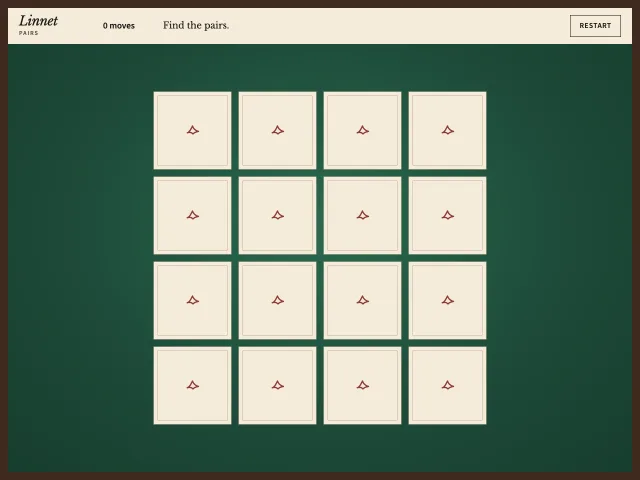
A 4 by 4 felt table of drawn cards. Flip two, a match stays, a miss turns back, moves count, and the win line names the moves.
Swipe-to-grade flashcard review
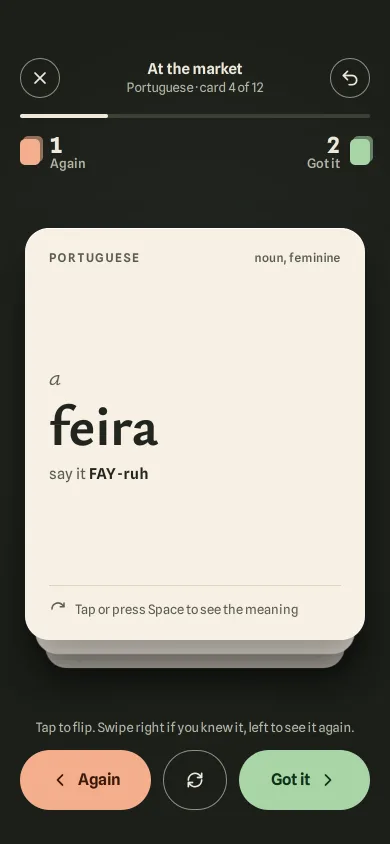
A vocabulary review deck: tap to flip the card in 3D, fling right for Got it or left for Again, with tilt, tint, a growing stamp, live piles and undo.
Daily game shop
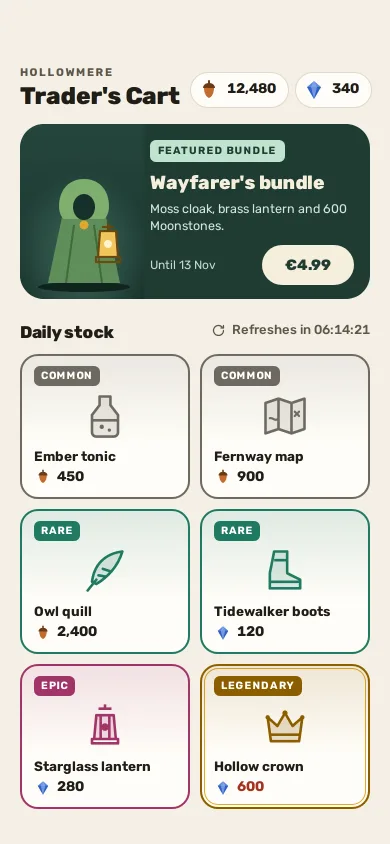
A fox-adventure game's daily shop: two currencies, one featured bundle in euros, six rarity-framed items, a plain refresh timer and honest confirm sheets.
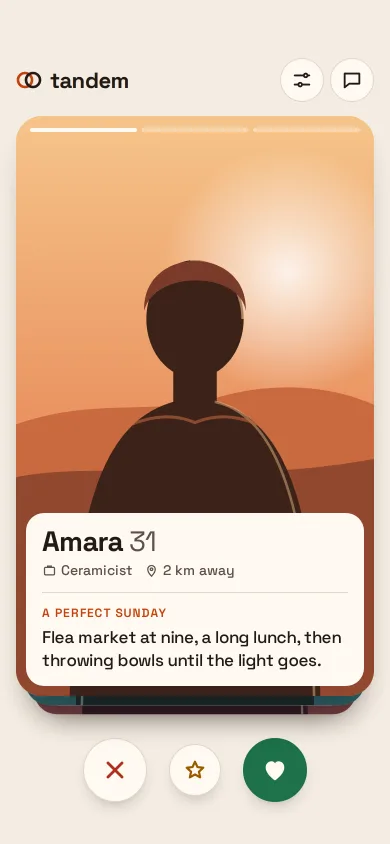
Dating swipe deck with match screen
A card stack for a dating app: drag to like or pass with rotation and LIKE/PASS stamps, velocity flings, a next card that grows in, and a calm match screen.
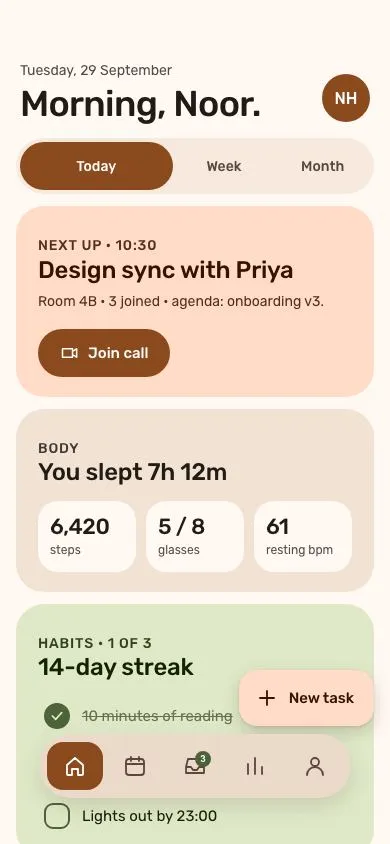
M3 Expressive home feed
A warm-tonal Material 3 Expressive home: 36px greeting, morphing segmented group with a shape loader, 28px tonal cards, a floating 5-action toolbar and an extended FAB.
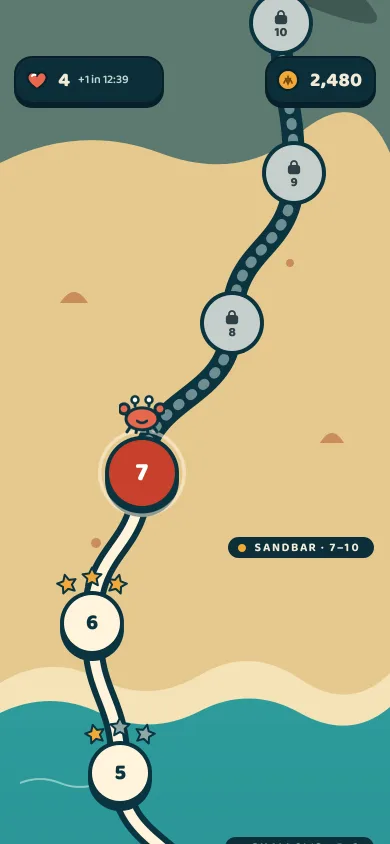
Phone level map
A saga-style level path climbing a tide-pool reef to a lighthouse: starred nodes, a pulsing current level, a level card sheet and a path that draws on clear.